Urban Beekeeping: Rules, Siting and Good Neighbours for Keeping Bees in the City
Keeping bees in a city is possible, but not anywhere and not in any way. Registration with the beekeeping registry, legal distances and the exemption that really matters in town, council and building rules, a site designed around the flight path, a water station, swarm control and good neighbours. Plus the three mistakes typical of rooftop starters.
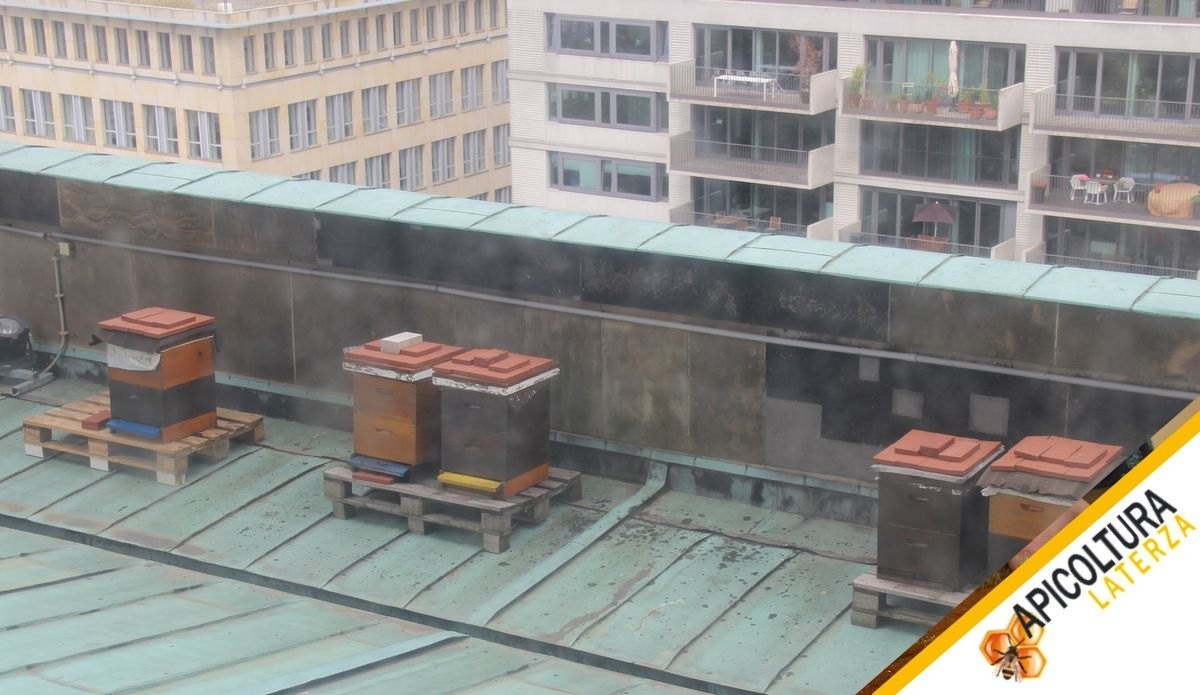
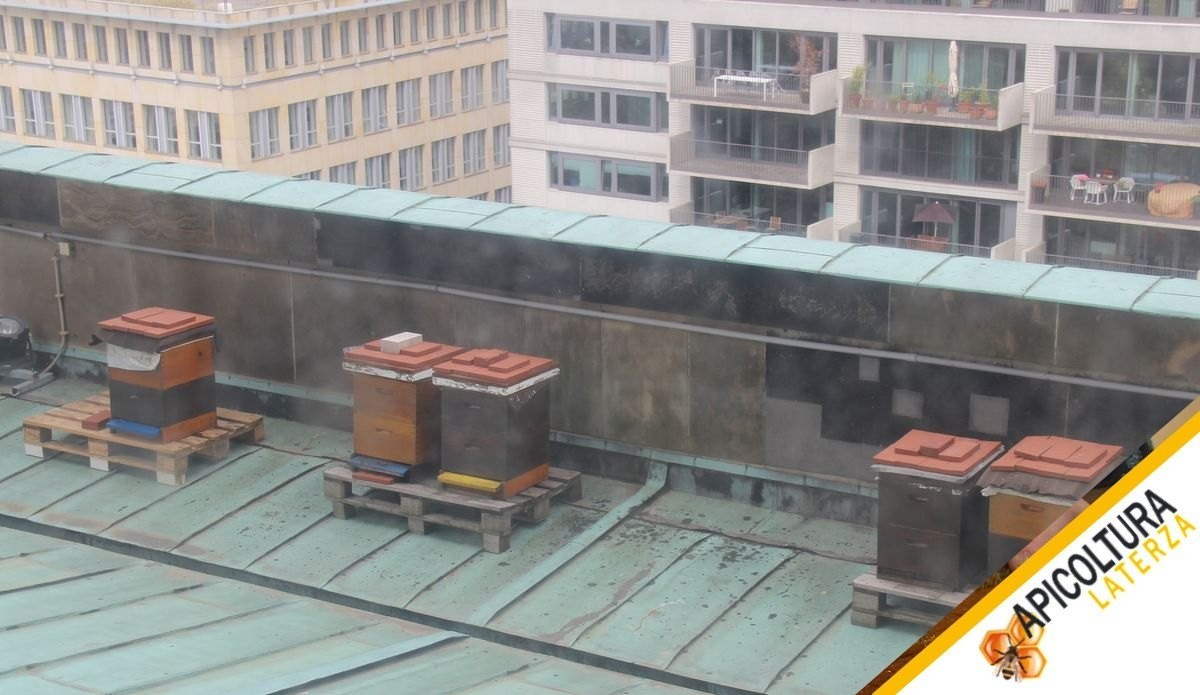
Three hives on a metal roof, apartment windows right behind them. It is not a provocation: it is a real photograph, and sites like that are becoming more common every year.
Urban beekeeping is appealing for understandable reasons. Some people have a terrace and want bees of their own, some run a community garden, some have a warehouse on the edge of town with an unused flat roof. The question we get is almost always the same one, and it is the right question: can it be done?
Yes. But not anywhere, and not in any way.
Technically, keeping bees in a city is no harder than keeping them in the countryside. In every other respect it is far more delicate: the rules are the same as for a rural apiary, but the neighbours are ten metres away instead of a kilometre. Here is what you need to know before you buy the first hive, not after.
The first step is not the roof, it is registration
Many people discover this stage too late, and usually they discover it the hard way.
In Italy anyone who keeps hives has to register with the national beekeeping registry, held in the National Database. It applies to a single hive, and it applies even if all the honey stays in the family and not one jar is ever sold. There is no minimum threshold below which a rooftop becomes exempt.
Registration produces a unique identification code, which must be displayed at the apiary on a readable sign. Every year the hives must then be counted and declared, in the window running from 1 November to 31 December, and any change has to be reported: new sites, moves, closure.
The procedure goes through the veterinary services of the local health authority, or through the associations and delegated technicians of your region. Operating details and deadlines can be updated, so always check with the competent desk in your area. It is one phone call, and it stops you starting on the wrong foot. If you are reading this from outside Italy, the principle is the same almost everywhere, but the registry and the deadlines are national: check your own.
Distances: what national law says
The Italian framework law on beekeeping sets two minimum distances for siting an apiary: at least ten metres from public roads and at least five metres from property boundaries, public or private.
In open country those numbers are usually easy to respect. In a city, read literally, they would rule out half the terraces in the country.
There is an exemption, though, and in urban settings it is the part that really matters. Those distances are not compulsory where there is a difference in level of at least two metres between the apiary and the road or the boundary, or where an unbroken barrier suitable to stop bees passing is interposed: a wall, a hedge, a fence. The barrier has to be at least two metres high.
In plain terms: a roof or a terrace raised above street level already sits inside the logic of the level difference, and a solid parapet of adequate height does the rest. This is not a loophole. It is precisely the technical principle the rule is built on, which is to force bees to gain height immediately, above people's heads.
Council and building rules: the ones nobody reads
National law is only the first layer. Above it sit regional rules, municipal public health and urban policing bylaws, and in a city very often the rules of the building itself.
Some councils explicitly regulate keeping animals in an urban setting; others say nothing and you fall back on general rules. It varies from place to place, and there is no answer that holds everywhere.
With shared buildings the point is even more concrete. A privately owned terrace is one thing, a communal flat roof is another. And a contractual set of building rules can carry specific bans that nobody has ever read, right up to the day a letter arrives from the managing agent.
The practical advice is obvious and saves months: before ordering bees, read the building rules and check with the council. If the site is on shared space or close to shared space, talk to the managing agent first. A project presented in advance gets discussed; a hive discovered afterwards has to be defended.
Siting: the flight path decides everything
Once the paperwork is sorted, the problem becomes geometric.
A bee leaving the entrance does not climb vertically like a helicopter: it sets off low and gains height as it goes. If there are three metres of open terrace in front of the hive and then a drop, the foragers will cross those three metres at knee height. If there is a barrier a metre and a half in front of the hive, they are forced to climb straight away and travel above two and a half metres.
It is the single measure that, on its own, settles most neighbour disputes. A stretched shade net, a panel, a row of tall planters, a trellis: anything opaque and continuous across the flight line.
Then there is the common sense that applies anywhere, but that weighs more in a city:
Entrance facing east or south-east, so the bees leave early and come back early. Never facing a used balcony, a window, a door or a walkway. Hives raised off the ground, both for airflow and for comfortable working. Room behind and to the side to open up without contortions, because on a narrow terrace an awkward inspection turns into a badly done inspection.
And one detail that is always underestimated on roofs: in summer a sheet metal or dark membrane surface turns into a hotplate. You need shade during the middle of the day, even just a light cover above the lids.
Water: if you do not supply it, they take it from the neighbours
This is the point that causes more arguments than anything else, and almost nobody plans for it.
A colony in full season uses anything but symbolic amounts of water, especially on hot days, to cool the nest and dilute stores. In the countryside they find it on their own. In a city they find it in the neighbour's dog bowl, in the saucer on the balcony opposite, along the wet rim of a paddling pool.
The answer is a dedicated water station, running before the bees arrive. Not after: once they have learned the way to a source, changing it is hard.
It takes very little. A wide shallow container filled with stones, corks, floating balls or straw, anything that floats and lets them land without drowning. Sunny in the morning, sheltered from wind, near the hives but not in front of the entrance. And above all always full: a water station that dries out for three days sends the bees looking elsewhere, and from there they do not come back.
How many colonies a city can really carry
Honesty is needed here, because enthusiasm plays tricks.
An urban site is not a production apiary. Two, three, at most four colonies is a sensible number for a roof or a terrace. Not for reasons of space, but because the foraging area is shared with every other honey bee in the district and with wild pollinators, which in a city already work with limited resources.
Multiplying hives in a neighbourhood where flowering is what it is does not produce more honey: it produces mediocre colonies and more pressure on solitary bees and bumblebees. If real production is the goal, the route is not loading up the roof: it is a site outside town, planned the way an apiary is planned. On sizing colony numbers against your time and resources we wrote a dedicated guide on planning an apiary and deciding how many colonies to keep.
In a city, temperament is not a detail
In the countryside a hot colony is a nuisance. On a terrace it is a serious problem.
Gentleness has a genetic basis: it comes from the queen and from the selection she came out of. It is not a trait you correct with patience or with more smoke. For an urban site it is worth starting with queens selected on calm lines, and it is worth paying properly for them: that is the part of the investment that spares you the worst trouble.
And if a colony turns aggressive, the answer is not to put up with it: it is to replace the queen, without waiting for next season. Within three weeks the population starts to change. If you want to understand which traits separate the most common lines, the comparison is in the article on Ligustica or Carnica and how to choose the queen, while the mated queen bees we rear are selected on this too.
Swarming in a city is not a romantic event
A swarm leaving a roof and settling on a tree in a park is a spectacular sight. A swarm settling on a cafe awning, on the handlebars of a scooter or on the cornice of a school is a call to the fire brigade and terrible publicity for every beekeeper in town.
In a city, swarm prevention stops being a production choice and becomes a responsibility. It means regular inspections every seven to ten days through the critical period, a brood nest that never gets congested, space given in advance, young queens.
Anyone who cannot guarantee that rhythm of spring checks should not keep bees in a city. It is a blunt sentence, but an honest one. The signs to recognise and the practical management are all in the article on swarming and how to manage it in spring.
Working without being noticed
A good urban beekeeper is an invisible beekeeper.
Inspections are done in the middle of fine days, when most foragers are out and the colony is calmer. You avoid the days and hours of heaviest traffic: Saturday afternoon on a shared terrace is not the moment.
Smoke is used sparingly and cool, because a thick cloud on a rooftop is visible from every window and frightens people more than the bees do. Frames are never left standing in the open and supers are carried closed: anything smelling of honey left outside in a city draws bees, wasps and hornets within minutes.
That goes double from August onwards, when nectar gets scarce and robbing and predator pressure begin. We covered the subject at length when writing about wasps and hornets at the hive: in an urban setting the same care also stops your roof becoming the meeting point for every insect in the district.
One last thing, and perhaps the most effective: talk to the neighbours before they start talking about you. A jar of honey and five minutes of explanation have settled more disputes than any set of rules.
City honey: what to actually expect
Cities are not food deserts, quite the opposite. Tree-lined avenues, parks, private gardens, planted terraces and ornamental species create a succession of flowerings often more continuous than that of a monoculture countryside, where after the main flow there is almost nothing left.
There are limes, black locust, maples, fruit trees in courtyards, flowering hedges, beds that get replanted several times a year. And the heat stored by buildings brings flowering forward in spring and stretches the season into autumn.
The result is almost always a wildflower honey with character, different from one year to the next, hard to replicate. Yields per hive tend to be lower than on a good rural site, but steadier.
On choosing the spot, one prudent and concrete criterion: avoid sites immediately alongside heavy traffic arteries or industrial operations, and prefer high roofs, inner courtyards, green areas. It is common sense, and it costs nothing to apply at the planning stage.
Winter on a roof is a different matter
On an exposed terrace cold is not the main problem: wind is.
A clustered colony copes with very low temperatures, but a constant draught on the entrance makes it burn through stores twice as fast. You need a screen on the side of the prevailing winds, you need the hive anchored or weighted, and you need to check that the lid does not travel during a gale.
The rest of the winter preparation is the usual: sufficient stores, a nest sized to the population, a floor that drains moisture. We set it out in detail in the article on wintering and preparing the hive for the cold season.
Three typical mistakes made by urban starters
Buying the bees before sorting the paperwork. Registration, building rules, council check. Three tedious steps that, done afterwards, become three problems.
Forgetting the water. Ninety per cent of neighbour complaints start with bees drinking where they should not. A water station costing ten euros, set up in good time, prevents all of it.
Adding hives because there is room. Physical space is not the constraint. The constraints are the flowering of the district and the time you have for spring inspections.
In short
Urban beekeeping works, and it is a fine thing to do. But it works on three conditions: the paperwork in order, a site designed around the flight path rather than around convenience, and gentle bees that are genuinely looked after.
Start from there and a city suits you well. Skip one of those three points and sooner or later you pay for it, usually in a way that involves the neighbour downstairs as well.
If you are weighing up your first site and you do not know how many colonies to start with or which bees to choose, that is exactly what we are here for. Tell us where the site is and what surrounds it: the rest we build together.
In a city, choosing the right bees counts twice
On a terrace or a roof, just any colony will not do: you need one that is calm, healthy and well led. We rear nucleus colonies and selected queen bees in our own apiaries and deliver them ready to work. Tell us where your site is and how many colonies you want to start with, and we will help you choose them.
In Same Category
- Wildflower, Monofloral or Honeydew: How to Tell Honeys Apart and Choose the Right One
- Swarming: Recognising the Signs and Managing It in Spring
- Planning Your Apiary for 2027: How Many Colonies and Which Bees
- How a Bee Colony Is Organised: Queen, Workers and Drones
- Newly Born Queen Bee: Birth and Life Cycle