Flowering Calendar: Planning the Year on Your Own Flight Radius
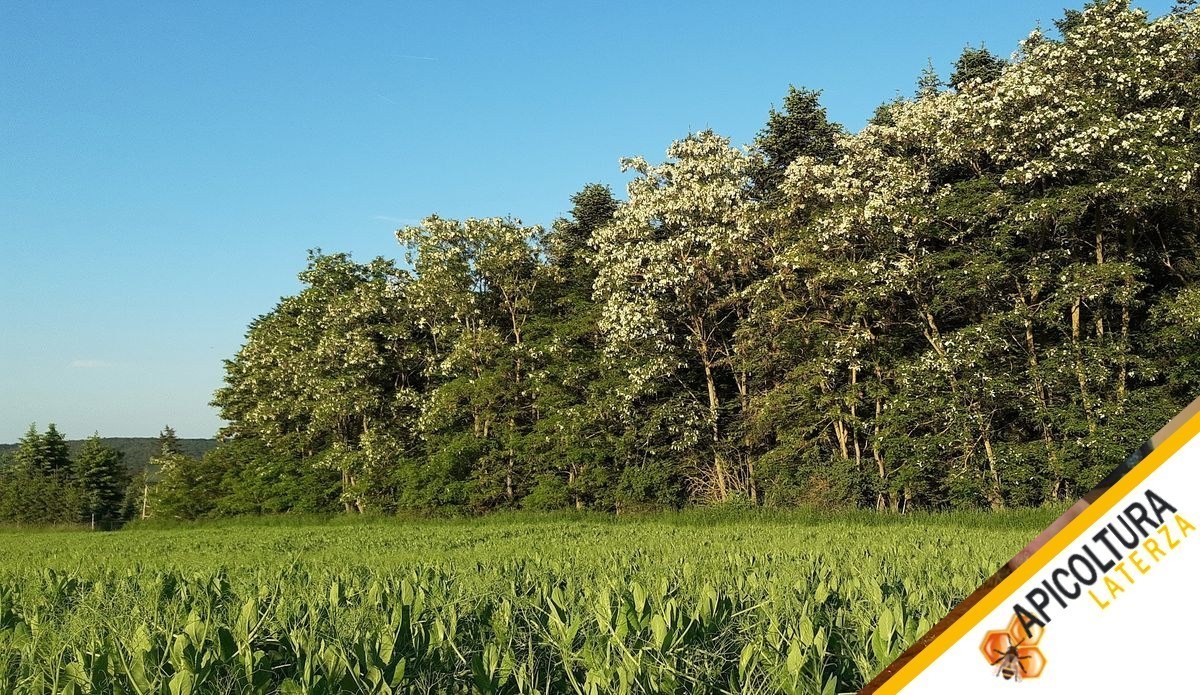
Black locust in May and chestnut in June are an average, and averages cannot be harvested. In Piedmont the onset of black locust flowering has moved forward by five days per decade, and within that trend single seasons swing a fortnight either way. Here we explain how to read flowering stages, why the date that matters is the one minus forty days, and how to build the record for your own flight radius.
Every beekeeper carries a calendar in their head. Black locust in May, chestnut in June, lime tree shortly after. We all learned it that way, from whoever taught us the trade, and we keep repeating it.
The trouble is that this calendar is an average. And averages, in the apiary, cannot be harvested.
This article is not yet another list of plants with months beside them. If the botanical side is what you are after, you will find it in our piece on the importance of pollens in beekeeping. Here we are doing something else: explaining why the date written on the calendar is of little use to you, and what to look at instead when deciding when to work. Which is the only real reason a flowering calendar exists.
The calendar in your head has moved
Let us start with a number, because on this subject opinions are plentiful and data are not.
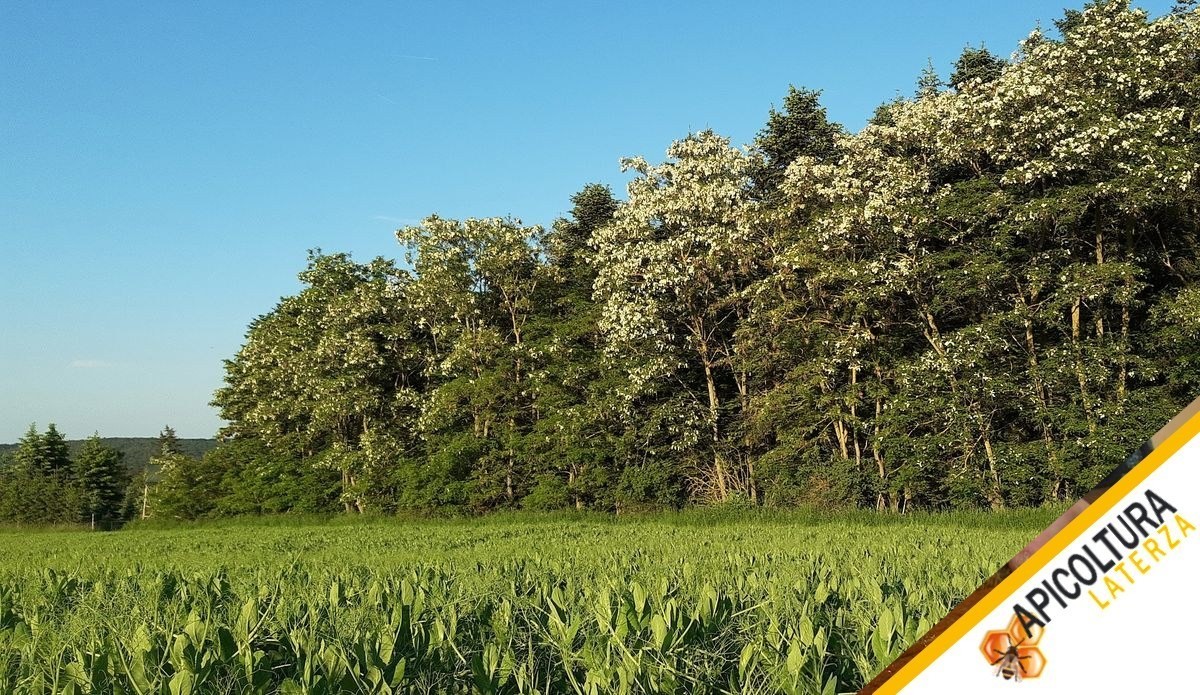
In 2026 the International Journal of Biometeorology published a study on black locust flowering in Piedmont. The historical series comes from a black locust wood near a beekeeping farm at Montaldo Scarampi, in the province of Asti, at 260 metres above sea level, and was collected every year from 1981 to 2025 by the regional honey producers association: forty observations, with gaps in only five seasons. The authors combined it with data from the national phenological network.
The result: flowering onset has moved forward by about half a day per year. Five days every decade. Over forty-four years that is roughly three weeks.
Three weeks is a lot. It is the difference between having your supers ready and chasing after them.
But there is a second number, and to our mind it matters more. Within that underlying trend, individual years swing considerably: the study records seasons up to fifteen days late and seasons up to twelve days early compared with the trend line. So your grandfather's calendar is three weeks out, and last year's can be two weeks out.
What "flowering" actually means
When two beekeepers tell each other "the black locust is out", they often mean two different things. One has seen the first white racemes; the other has a whole wood turned white.
People who record phenology for a living solved this problem long ago, with an international scale called BBCH. For black locust, in the version adopted by the Italian network, the steps that concern us are these:
- 51 inflorescence or flower buds visible
- 55 first buds visible, barely developed
- 57 developed buds with petals visible
- 60 first flowers open
- 61 ten per cent of flowers open
- 65 full flowering, at least fifty per cent of flowers open
- 67 flowers mostly faded
- 69 end of flowering, all petals fallen
The recording rule is straightforward: you note the most advanced stage present on more than ten per cent of the plant's organs, observing at least ten plants per station.
Now look at that scale through the eyes of someone who has work to do. Stage 57 tells you there are still a few days to sort out the supers. Stage 61 tells you the race has begun. Stage 69 tells you the harvest is closed, whatever the calendar still says.
A calendar that says "May" tells you none of these three things.
The forty-day rule
There is a technical, and very concrete, reason why the flowering date on its own is nearly useless.
A worker bee takes about twenty days from the laying of the egg to emergence. She then spends her first fifteen to twenty days on duties inside the hive, and only in her last twenty days or so does she become a forager. Do the arithmetic: the bee that works the black locust was an egg some forty days earlier.
This is why pollination management handbooks state that laying must be stimulated at least forty to fifty days before the flowering you are aiming at. It is not a refinement for professionals. It is arithmetic.
The practical consequence is that the date to mark on your calendar is not the flowering date. It is the flowering date minus forty days.
A beekeeper who realises in late March that the black locust is early still has room to work on the colonies. One who realises it on the day the wood turns white can only hope the bees are already there. We devoted a whole article to this step, on spring checks at the hive.
The calendar that counts is the one for your flight radius
Bees do not forage on the best nectar in the country. They forage on what is within reach.
Below ten to twelve degrees they do not fly at all. In poor conditions, with wind or cold, they will not go more than one or two hundred metres from the hive. In fine weather and high temperatures they will cover kilometres, but they always choose the most convenient source, not the most prestigious one.
This means the useful calendar has no regional boundary. It has a radius. And inside that radius you may have a huge flowering that the national calendar does not even mention, or you may simply not have the flowering everybody else is counting on.
If you are still choosing where to put your hives, this ties directly into how a site is assessed, which we covered in sedentary beekeeping and how to choose the right place.
Surveying the flora: done once, good for years
The job is less romantic than it sounds. You do it on foot, with a sheet of paper.
You walk the apiary's radius, season by season, and write down what is in flower: the species, where it is, how much of it there is and how it is exposed. The "how much" is the entry almost everyone skips, and it is the most important one. Two black locusts in a neighbour's garden are not a flowering. A kilometre-long hedgerow is.
As you walk, sort what you see into three groups:
- harvest flowerings, the ones that combine volume and nectar;
- build-up flowerings, which give little or no honey but bring pollen and make brood;
- gaps, the periods when nothing useful is in flower within your radius.
The gaps are the most valuable part of the map. They are what tells you when you will have to step in yourself, and what it will cost you.
The flowering record: three columns are enough
The survey tells you what is there. The record tells you when.
Nothing complicated is needed. Three columns: date of first open flowers, date of full flowering, date when the petals have fallen. One row per species, one sheet per year.
Add a fourth column with a couple of words about the weather. Without it, in three years' time you will not understand why a given season went wrong.
The reason this record works is not that it will give you the average of the dates, although after three or four seasons it will. The reason is that it gives you the sequence: how many days pass, where you are, between dandelion and black locust, between black locust and chestnut.
The sequence is far more stable than the date. If spring arrives a fortnight early, the whole block shifts, but the intervals stay roughly the same. And it is with the intervals that you plan your work.
Altitude, aspect, latitude: why two apiaries twenty kilometres apart have two calendars
The Italian phenological network follows stations spread from 37 to 46 degrees north. Italy is a long country, and the same species flowers across an arc of weeks.
But it is not only a matter of north and south. The models used to build phenological maps do not count days: they count accumulated heat, converted into thermal units along the response curve of each species. That is why altitude, the aspect of the slope and even the proximity of a body of water shift the date without moving the plant an inch.
One figure to give you the order of magnitude, taken from the Piedmont study: one degree more in mean maximum temperature between 1 March and 15 April is associated with black locust flowering about four and a half days earlier. With a two-degree anomaly the estimated advance rises to seven or nine days.
You will not find in this article a fixed rule of the "so many days per hundred metres" kind, because it varies with the species and the season, and giving you one would be convenient but dishonest. That measurement, within your flight radius, is one only you can make, with the record.
The national sequence, to be read as background
All of which said, an overall picture is useful. Not for marking dates, but for knowing what comes before what.
Across most of the country the order runs like this: the late-winter flowerings, almost all of them pollen sources; then spring, with citrus in the south and black locust in the centre and north; then early summer, bringing lime, chestnut and mountain honeys; then the summer flowerings of the lowlands; and finally the closing stretch of the season, the part that serves the bees rather than you.
Take it as a running order, not as a railway timetable. Which honey is typical of each block depends on your territory: if you want to understand what sets a wildflower honey apart from a monofloral and from honeydew, we explained it in our article on wildflower, monofloral and honeydew honeys.
Late winter: the flowerings you do not harvest but that decide May
Hazel, alder, willow, dandelion, cherry. None of them will fill a super for you, and that is precisely why they get overlooked.
Yet these are the flowerings that build the bees which will forage in May. The forty-day rule comes back: March brood is May harvest.
The 2026 season showed clearly how delicate this passage is. According to the monthly surveys of the Italian National Honey Observatory, a mild start to March had encouraged good colony development, but the negative temperature anomalies of the last ten days interrupted the flows; in Piedmont and Lombardy the late March frosts caught black locust already in a sensitive stage, with visible damage to the buds.
A late March frost does not ruin March. It ruins May.
Spring: black locust and the problem of the short window
Again from the Observatory's surveys, in April 2026 black locust flowered notably early in some areas, and that earliness translated into a relatively short but fairly generous flowering: mixed harvests, generally good to very good, above all in the plains and in low to medium hill country. In May, cold returns, frequent rain and hail penalised the later areas and those at higher altitude.
For citrus the picture was harsher: across many areas of the south and the islands production was unsatisfactory or well below average, with yields in some cases close to nil. Only Puglia, and in particular the most suited areas of the province of Taranto, confirmed a better trend. Being at home in these parts, that is something we saw with our own eyes.
The operational point, though, lies elsewhere. On a short flowering there is no making up for lost ground. The super goes on before it is needed, not when it is needed, and it comes off by reading the plant rather than the calendar: we dealt with when and how in our article on the honey harvest and the right moment to remove the supers.
Early summer: altitude takes its revenge
In 2026 it was the beekeepers with apiaries in the hills and mountains who had the better season.
Mountain and mid-altitude zones benefited from the alternation of rain and warm spells, with satisfactory harvests of lime, chestnut and high-mountain honeys. On chestnut the Observatory recorded production averaging between ten and twenty kilograms per hive, with differences tied above all to two factors: the altitude of the apiary and the timeliness of hive placement in the productive areas.
Read that second factor again. "Timeliness of placement" means calendar. It means that between two beekeepers with the same bees, in the same wood, the difference in yield was made by whoever got there at the right moment.
If you are tempted to follow the flowerings by moving your hives, before buying the trailer read the figures we set out on migratory beekeeping and when it really pays. We ourselves, by choice, work sedentary.
Summer: when the heat shortens everything
The second half of the 2026 season taught a lesson worth putting in the calendar.
The heatwaves that affected much of the country accelerated the course of the summer flowerings, in many cases reducing their duration. In the lowlands the record heat cut the yields of the summer harvests, eucalyptus and wildflower honey first among them, while the cooler zones held up.
A flowering that lasts less is not automatically a flowering that yields less. But it is a flowering that leaves you no margin: if you arrive with colonies at half strength, there is no time to recover.
End of season: the flowerings that serve the bees, not you
The last flowerings of the year are the ones on which the winter bees are built, and winter bees are different from summer bees: they have to make it through to March.
This is the moment when the calendar changes job: it stops telling you when to harvest and starts telling you when to stop. From here on the subject is no longer the super but the stores and the strength of the colony, which we covered in our article on wintering the hive.
Public phenological forecasts: they exist, they are free, use them
This is the part most often missing from conversations between beekeepers, which is a pity, because it is a public service that has been running for twenty years.
IPHEN, the Italian Phenological Network, began in 2006 with two declared aims: to produce analysis maps, showing the current state of phenology, and forecast maps, showing the date on which a given stage is expected. Among the project's promoters, alongside the scientific societies of aerobiology and agrometeorology, is the national union of Italian beekeepers associations.
Two of the species followed matter to us more than the others: black locust and chestnut. Black locust, the project document states, was chosen partly because it is important for the production of acacia honey.
The bulletins come out weekly, produced by CREA Agriculture and Environment, and are published on the website of the National Rural Network. Inside you will find the weather commentary for the week, analysis maps with the development stage reached, and forecast maps where, for instance, the end of black locust flowering is given as a day of the year. The outputs refer to a two-by-two kilometre grid.
Who collects the data is the detail we like best: volunteer observers, largely beekeepers, who look at at least ten plants per station once a week and send in their sheet before the maps are issued.
One necessary caveat on reliability. In the Piedmont study the model based on the winter index produces mean absolute errors of around five and a half days, comparable to the weekly resolution of the observations. The authors say so plainly: an indication of this kind should be read as a window of a few days, not as an exact date.
In practice: a phenological forecast tells you which week to get ready in. It does not tell you the day to load the van.
The calendar is moving, but not uniformly
Here some honesty is needed, because on climate it is easy to claim more than is known.
That black locust flowering in Piedmont has advanced by five days per decade is a solid figure, over a forty-four-year series. But it is a local figure, on one species.
The national indicator on the variation of phenological calendars, built on observations spanning at least twenty years and updated to 2024, returns no uniform signal: some autumn stages come out significantly earlier, some early reproductive stages come out later, and for many species-and-stage combinations no statistically significant trend emerges at all.
The moral: do not automatically transfer the figure for one species to all the others, and do not transfer the figure for one region to yours. The general direction is that one, but the number that concerns you has to be measured in your own apiary. Which is exactly why a flowering record is worth more than any table downloaded off the internet.
Three mistakes that cost you the harvest
Putting the supers on when you can see the flowers. By then the colony that was supposed to work that flowering either exists already or cannot be made in time. The real work was forty days earlier.
Trusting last year's date without looking at what the weather did in March. A warm spring can shift flowering by a good week, and the same warm spring followed by a late frost can wipe it out altogether.
Building the calendar on species instead of on volume. Listing what flowers within your radius is easy and makes you feel organised. But until you write down beside each entry how much of it there actually is, you are compiling a herbarium, not a plan.
In two lines
The national flowering calendar is there to tell you the order of things. The useful dates are three, and you have to build them yourself: when flowering starts within your radius, when it ends, and that date minus forty days, which is when the work actually happens.
The rest, public phenological maps and the March weather, is there to correct your aim as you go. Which is the only honest way to use a calendar in beekeeping.
You build the calendar, we can have the colonies ready in time
A flowering calendar is of little use if the colonies are not there forty days before the bloom. We produce and sell nucs, colonies, package bees and selected queens, with delivery windows set well in advance. Tell us where your apiary is and which flowerings you are counting on, and we will tell you what to get there with and when we can deliver it.
In Same Category
- Contract Pollination: How the Service Works for Growers
- Pollen and Propolis: What You Need to Harvest Them and When It Pays
- Urban Beekeeping: Rules, Siting and Good Neighbours for Keeping Bees in the City
- Wildflower, Monofloral or Honeydew: How to Tell Honeys Apart and Choose the Right One
- Swarming: Recognising the Signs and Managing It in Spring