Migratory Beekeeping: When Moving Hives Really Pays
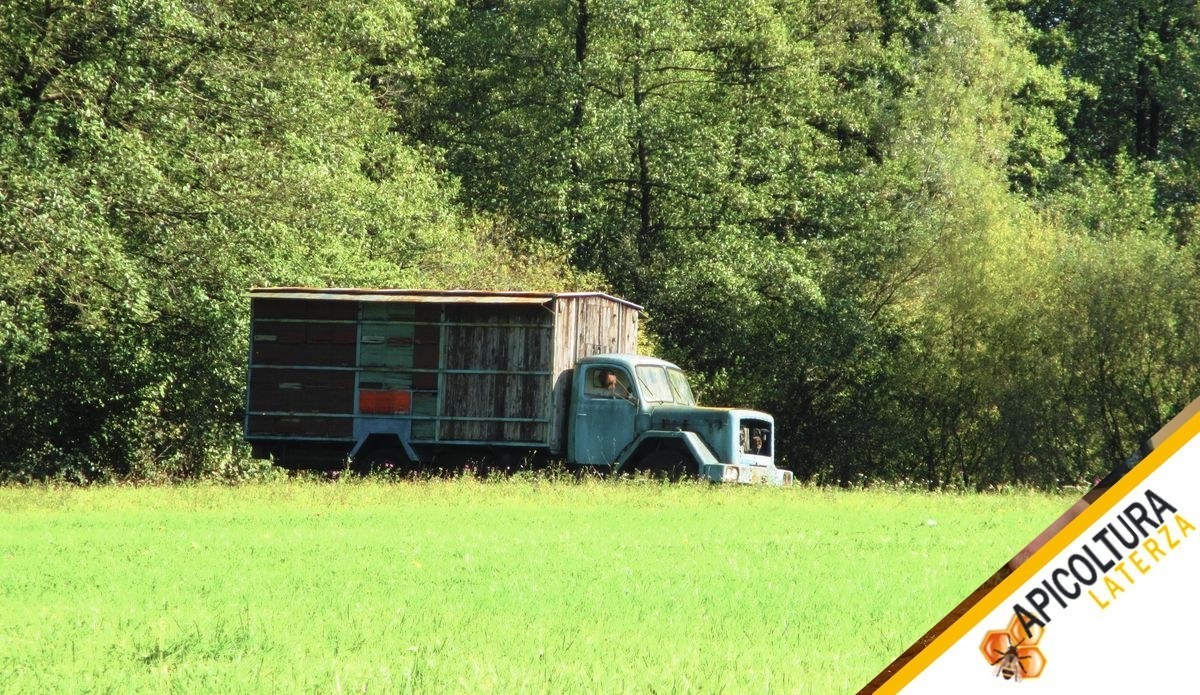
Migration is not a style of beekeeping: it is an economic decision taken afresh every year. 2026 yields per hive, the full calculation of trips and hours, the three kilometre rule corrected, what has to be recorded when you really move hives, and the penalties in force today, which are not the ones in the old articles.
In 2026 the Italian National Honey Observatory recorded two situations that, placed side by side, explain migratory beekeeping better than any speech. On lowland lime the simultaneous flowering of tree of heaven pushed almost the whole crop into the wildflower category. On mountain lime, where the beekeepers who had moved were waiting, the estimated average yield was around 27 kilos per hive.
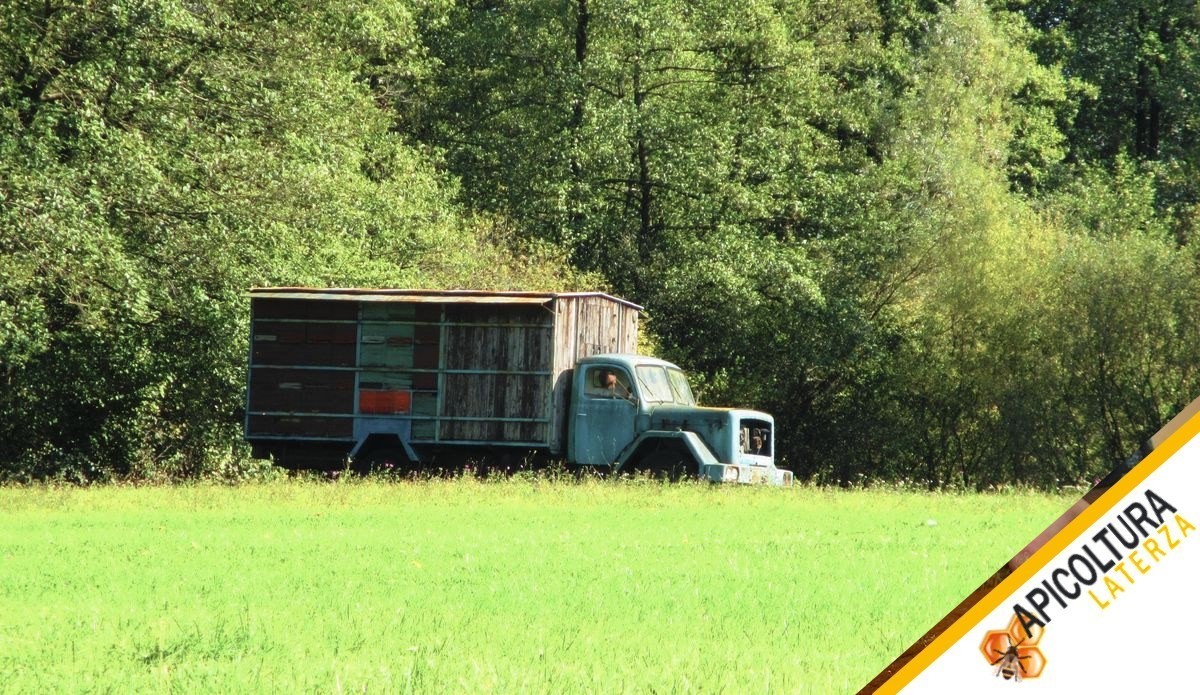
Same insect, same week, two different outcomes. In between there is a lorry, a few hundred kilometres and a decision taken a month in advance.
This article is not about what migratory beekeeping is: we already covered that in what nomadic beekeeping is. Here we try to answer the question asked by someone who already keeps bees and is weighing whether to move them. Does it pay? And under what conditions?
What "migratory beekeeping" means in law
It is worth starting from the definition, because in Italy it is written into a statute and because it is narrower than everyday usage. Law 313 of 24 December 2004, article 2, defines migratory beekeeping as the management of a bee operation for the purpose of increasing production, involving one or more movements of the apiary during the year.
Two phrases matter more than the rest. For the purpose of increasing production: moving your hives because a neighbour is complaining is not migratory beekeeping, it is a relocation. And during the year: this is a rotation, not a permanent transfer.
The same law calls the site of an apiary a "postazione", a standing place. That detail comes back later, because nearly every obligation we will look at revolves around one thing: which point on the map your bees are on, and since when.
The first figure to look at is not total honey, it is yield per hive
Anyone assessing a move by thinking of the tonnes they would bring home is using the wrong unit. The figure that decides is yield per hive, because it is the only one you can set against the cost of moving that hive.
The 2026 surveys give some concrete reference points. Mountain lime, professional beekeepers practising migration: around 27 kilos per hive. Rhododendron and high mountain wildflower honey in the Alps: around 19 kilos. Chestnut: a very wide range, roughly between 10 and 25 kilos.
On that chestnut range the Observatory adds the most useful remark of the year: the differences were put down mainly to the altitude of the apiaries and to how promptly the hives had been placed in the productive areas. In plain words: for the same site, arriving late costs as much as not going at all.
The calculation few people finish
Let us put numbers on it, with the caution they deserve. In the same year, wholesale prices for the main monofloral honeys sat between 6.00 and 7.50 euro per kilo, with acacia between 8.00 and 10.00 euro.
Suppose the move gains you 10 kilos per hive compared with staying put. On 30 hives that is 300 kilos, around 2,000 euro of gross value. It sounds like a lot. Now subtract the trip out, the trip back, the scouting visit to see the site, the loading and unloading hours, the fuel, the wear on the vehicle, any agreement with the landowner, and the two or three inspection runs that on a distant site cost a day each.
The margin is still there, but it is far thinner than it looked. And it turns negative quickly if the flow does not hold, if you arrive eight days late, or if you have to come home empty.
That is why migration, in practice, pays off on large numbers: the same driving hours serve twenty hives or a hundred, but the return changes fivefold.
The three kilometre rule, and why it needs correcting
The rule you hear everywhere is the three kilometre one: below that distance foragers return to the old site, above it they reorient. Unaapi, in its ABC of beekeeping, takes it apart patiently and it is worth following the argument.
Three kilometres is the distance commonly assumed to be the flight range of bees, but reality is more nuanced. A study by Visscher and Seeley, based on observing recruitment dances, found that 5 per cent of recruiting bees were indicating distances of over 6 kilometres, with extremes of 10 and 11. An experiment run by professor Ratnieks and his students in Sheffield showed that during autumn heather flowering almost all the bees went beyond three kilometres to reach a richer forage.
The reason the rule needs correcting is geometric. If you move three kilometres, the area the bees worked from the old site and the one they will work from the new site overlap: a forager that ends up in the overlap recognises the landscape and goes back to where it was. You need a band of unknown ground between the two areas. Seven or eight kilometres are much safer than three.
This is not pedantry. The proof that a move failed is hundreds of bees flying about lost on the old site, and colonies reaching the flow with fewer foragers than they need precisely in the days that count.
Short moves are a different craft
Sometimes you have to shift a hive by a few metres, because the farmer needs to work right there or because you set the row out badly. Here distance works against you.
There are three workable routes. The first: move the hive about a metre a day until it reaches its new position, which works well for a single hive and badly for a group. The second: take it far away, leave it there long enough, then bring it back to the new spot. The third, the most underrated, is to exploit the amnesia of a freshly hived swarm, the one case in which bees have no intention of going back where they came from.
How long should the exile last? Not three days, as the American formula has it. Maurice Vuillaume's experiments of 1959 showed that the memory of the entrance position lasts at least twelve days, and that in bees confined by winter frost it survived intact for as long as thirty. More recent work places the start of long term memory loss between the sixth and ninth day.
One practical note: within about twenty metres bees can still recognise the new position, with some effort. Beyond that they drift, and drifting happens not only between hive and hive but between apiaries in the same area.
You leave at night, and you leave with air
Hives are moved when all the bees are inside, which means after dusk or before dawn, and in the coolest hours. This is not folklore: a load of closed hives in the heat warms itself up, the bees fan, humidity rises and in the worst cases new comb collapses under its own weight.
The essentials are few and always the same. Close the entrance with a screen that lets air through. Hives ventilated top and bottom, with the open mesh floor if you have one. Frames locked in place, because a swinging frame crushes bees and breaks brood. Brood box, super and crown board strapped together as a single block.
Loading deserves an extra word. Moving hives by hand looks feasible the first time; by the third site you understand why anyone who migrates seriously owns a trolley, a lifting clamp or a crane arm. We went into this when we wrote about equipment for a growing apiary.
Finally a point about liability: if bees escape during transport, the driver of the vehicle is answerable for it. That is an excellent reason not to set off with improvised closures.
The vehicle: check the registration document before the weather
In Italy, transporting bees by motor vehicle does not require the health authorisation of the vehicle provided for by the veterinary police regulation. It does require the vehicle to be classified for mixed transport of people, animals and goods.
Any modification you make to the vehicle, a lifting arm for instance, has to be authorised by the vehicle licensing office and entered on the registration document. If you use lorries with a total transported weight above six tonnes, you need an own account goods transport licence.
Using a vehicle for a purpose other than the one stated on its registration document is penalised under article 83 of the Highway Code, with suspension of the document as an additional penalty. It is the kind of check you never expect on the night you get stopped.
Heavy vehicle bans do not apply to you (but check the year)
This is good news many beekeepers are unaware of. The annual calendar of circulation bans for goods vehicles over 7.5 tonnes contains explicit exemptions for the sector.
In decree 325 of 12 December 2025 from the Italian Ministry of Infrastructure and Transport, which sets the 2026 calendar, the ban does not apply to vehicles carrying live animals such as bees for migratory beekeeping, and unjarred honey is among the goods not subject to the ban.
The calendar is reissued every year: before planning a transfer on a restricted day, check the decree in force.
The paperwork has changed, and almost nobody says so
This part needs care, because much of what you read online is out of date.
For years the reference was article 6 of law 313/2004, the apiary declaration to the local health authority, together with the 1,000 to 4,000 euro penalty introduced by law 154 of 2016. Both provisions were repealed by legislative decree 134 of 5 August 2022, which lists them by name among the repealed measures in article 22.
The framework today is European regulation 2016/429 and that same decree 134/2022. The frame changes, the substance does not: bees remain traced animals, and the decree states that in beekeeping the holding is the apiary, that is, the unitary set of hives of one operator placed in the same physical location.
Four live obligations remain. Registration in the National Database before starting the activity. Notification of changes within seven days. An identification sign near every apiary. The annual census, updated between 1 November and 31 December each year with numbers, address and geographic coordinates of the apiaries.
What has to be recorded when you actually move hives
The principle is simple: movements of hives, package bees and queens must be recorded in the database, whatever their purpose, migration and pollination included.
The exception, the one that matters most to anyone working several nearby sites, covers movements between apiaries of the same owner that take place within the same province and do not activate or deactivate an apiary: those are not recorded.
On timing, the settled guidance is to record the movement before it starts or at the latest as it starts, with the option of completing the data in the following seven days. Queen movements may be reported cumulatively on a monthly basis.
Since 2025 the operating manual has been simplified on several points that bear directly on migration: the decree of 27 January 2025, published in Official Gazette no. 63 of 17 March 2025, established among other things that the sign is only needed when the site is occupied by hives and no longer has to show the apiary number, that movements of queen cells and brood frames are no longer recorded, and that empty sites still have to be declared at zero hives.
A warning that applies to this whole chapter: operating procedures change and the way they are applied has a regional component. Before a migratory season, a visit to the veterinary desk of the local health authority and a check of your own position in the database are worth the time they cost.
What getting it wrong costs
The penalties in force today are those of decree 134/2022, and they are higher than the ones still circulating in old articles.
- Failure to register in the database: from 750 to 7,500 euro.
- Failure to notify changes or cessation: from 150 to 1,500 euro for each item of information not reported in time.
- Apiary without an identification sign: from 150 to 1,500 euro for each irregular apiary.
- Annual census not recorded: from 300 to 3,000 euro for each apiary.
Two details worth keeping in mind. First: several penalties apply per apiary, so anyone working many sites multiplies them quickly. Second: the decree provides for the amounts to be updated every two years against the national consumer price index, so read the figures above as orders of magnitude.
The site: where you may put bees and how far away
Minimum distances are those of article 896-bis of the Italian civil code, introduced by law 313/2004: at least ten metres from public roads and at least five metres from the boundaries of public or private property. The distances are not compulsory where there is a difference in level of at least two metres between the apiary and those places, or continuous walls, hedges or other screens at least two metres high. Agreements between the parties still stand.
There is also a rule aimed specifically at crowded sites: regions may set a respect distance between apiaries of at least fifty hives, within a maximum radius of two hundred metres. It exists to stop two businesses from stacking up on the same flow.
On land availability, the law also says public bodies shall facilitate the placing of hives on land they own. In practice, though, what really counts is a clear agreement with whoever owns the ground: access, period, who maintains the surroundings, what happens if the land is sprayed.
One last point, and not a minor one: many Italian regions have their own rules on migratory beekeeping, with seasons, notifications and limits. Check those of the region you are moving to, not only your own.
Health status travels with the bees
Law 313/2004 calls for a prior check: apiaries, whether stationary or migratory, must comply with the veterinary police regulation. The movement also travels with an accompanying document, nowadays completed in the database.
Behind the formality lies a concrete reason every beekeeper should take personally. Migration is the most efficient way there is to move a health problem from one part of the country to another. A colony with a suspected brood disease does not go on the lorry: it stays, it is examined and, if need be, reported, as we explained in brood diseases.
Varroa needs attention too. Concentrating many hives from different businesses on the same flow means exposure to reinvasion, and the bill falls due in late summer, not in June. Anyone migrating has to plan treatments around the movement calendar, not the other way round: we covered this in late summer varroa treatment.
Three recurring mistakes
Setting off without having seen the site. A flowering area seen from satellite tells you nothing about access with a loaded vehicle, the slope, the shade in the hot hours or the water available. A scouting trip costs a morning and saves ten.
Taking weak colonies to a strong flow. Migration does not build colonies up: it tests them. A colony that does not already have the population to fill supers comes back more tired than before and with the same honey it left with.
Forgetting the aftermath. You come home with full supers and put everything else off. But after a crop there are stores to check and a season to close: you will find extraction explained in the honey harvest and winter preparation in wintering.
And what if the right answer were to stay?
Here we have to be honest, because this is our own choice. Apicoltura Laterza keeps bees in fixed apiaries: we work a territory diverse enough to give us different honeys in the same part of the season, with our hives well away from built up areas, and we have preferred to invest in continuity and control rather than in kilometres.
It is not an ideological stance, and 2026 showed it well. In the southern and island regions the citrus crop was poor or clearly below average, with yields in some cases close to zero: only in Puglia, and particularly in the most suited areas of the province of Taranto, did things go better. That year, in that place, there was nothing to chase.
Migration is a tool, and like every tool it has a field of use. It pays when you have enough hives to dilute the cost of the trip, a suitable vehicle, strong colonies, sites you have already seen and your paperwork in order. If even one of those five pieces is missing, the right year to start is probably next year.
If what you are after is not moving bees but putting them to work for someone else, that is a different conversation: we wrote about it in contract pollination. And if you are thinking of increasing the number of colonies before the number of sites, you can start from collecting and transporting nuclei and package bees.
A strong colony is worth more than one more trip
Whether you choose to move or to stay, the crop starts with the bees inside the hive. We produce and sell nucs, colonies, package bees and selected queens: tell us how you work and we will help you work out what you really need, and when we can deliver it.
In Same Category
- The Italian Beekeeping Register: Registration, Apiary Sign and Census
- Selling Honey: Labelling and Direct Sale Without Mistakes
- Hive Materials Compared: Wood, Polystyrene and Sizes, What Really Changes
- Brood Diseases: Reading the Signs and What the Law Requires
- Beeswax: How to Recover Cappings and Old Combs and Get Your Foundation Back