Beeswax: How to Recover Cappings and Old Combs and Get Your Foundation Back
Cappings from the harvest and old combs are not waste: they are wax the bees have already paid for. Which combs to cull and how many each year, how to render without darkening the wax, why the bottom of the block must be scraped, how to protect combs from the wax moth and what to ask a processor before exchanging for foundation.
At the end of the season there is a bucket in almost every beekeeping store. Inside are the cappings from the harvest, still sticky with honey, covered with a lid or an old cloth. Quite often they are still there a year later.
Meanwhile, old frames pile up in a corner: black combs, heavy, with cells that have slowly grown narrower. Nobody throws them away, because that feels wasteful. Nobody processes them either, because that feels like a chore.
It is a shame, because that material is worth something. Not a fortune, but something real: bees burn a considerable amount of honey to build a single kilo of wax, and the figures most often quoted talk about several kilos of honey per kilo of wax. Throwing it out means throwing out work the bees have already done and already paid for.
This guide covers how to recover beeswax without spoiling it, which mistakes darken or emulsify it, and how to bring it back to the apiary as foundation.
Wax is not waste: it is a second harvest
Beeswax is produced by the wax glands of young workers. It takes energy, it takes a warm nest, it takes time. It is not free material, neither for the bees nor for you.
In practice, recovered wax has three sensible destinations: it goes back to the apiary as foundation, it is sold to a wax processor, or it stays in the store as a small reserve. The first is almost always the most convenient, because it closes the loop without buying wax of unknown origin.
There is one more reason that never appears in the accounts but matters: the wax you put back into your hives is the wax your own bees built, with a treatment history you know. Over the years that counts.
The three kinds of wax in your store (and why to keep them apart)
They are not the same thing, and mixing them is the most common mistake.
Cappings wax is the best you will ever handle. It is new wax, built during the season, pale, essentially free of accumulated residues. It comes from uncapping the supers: for the moment it is produced, see our article on the honey harvest and when to remove the supers.
Burr comb and scrapings are the wax you take off crown boards, top bars and trap frames. Usually decent quality, but dirtier with propolis and wood.
Cull combs are the old brood frames. Here the wax is dark, loaded with cocoons, and it is not the valuable part of the job.
Three separate buckets, labelled, and the rest of the work gets simpler on its own. One single bucket for everything forces you to treat even your cappings as second-rate material.
Which combs to cull, and how many each year
The rule of thumb that works is simple: replace about a third of the brood combs every year. That way no frame stays in the hive for more than three seasons.
Why so many? Because every brood cycle leaves the pupal cocoon inside the cell. Cocoons build up, the cell narrows, the comb turns black and gets steadily heavier. Bees raised in progressively narrower cells tend to be smaller.
There is a second reason, less visible and more serious. Wax is a fatty material, and many molecules used in beekeeping are fat soluble: synthetic acaricides in particular tend to accumulate exactly there. A comb left in the hive for six or seven years is a sponge that has absorbed everything that passed through it.
Add that old combs hold spores and disease agents more readily, and comb renewal stops looking like textbook fussiness. It is ordinary maintenance.
How do you pick the ones to pull? Hold them up to the light. If no light comes through, if cells are deformed, if there are patches of chalkbrood or badly patched holes, that frame goes. The best moment to make the selection is the spring build-up, when you are opening the hives anyway for the spring checks at the hive: old combs are gradually moved to the outside of the nest and removed once they are free of brood.
How much wax an old comb really yields
Less than you think. A good deal less.
A black brood comb is heavy, but most of that weight is not wax: it is cocoons, propolis, pollen residue and dirt. Rendering recovers only part of it, and the rest stays in the waste cake, the slumgum.
Cappings, on the other hand, yield beautifully: once washed free of residual honey they are almost pure wax.
Two things follow. First, if you run a handful of colonies, the wax that matters is the wax from the supers, not from black combs. Second, if you are thinking of buying a sophisticated wax melter to process ten frames a year, the numbers do not add up. As with the rest of your beekeeping equipment, buy in the right order and only when the numbers justify it.
Rendering the wax: sun, steam or a pot
Beeswax melts at around 62 to 65 degrees Celsius. That is a low figure, and it opens several routes.
The solar wax melter is an insulated box with a glass lid and a sloping tray: the sun does the rest and the wax runs into a container below. Cheap, no running costs, no supervision needed. It is perfect for cappings and pale combs, far less effective on black combs, which trap wax inside the cocoons. Use it on genuinely sunny days, otherwise it half warms and the wax stays as a paste.
The steam wax melter is the step up for anyone with volume. A steam generator heats a chamber where you load whole frames: the wax runs out, the woodwork comes out clean, the cocoons stay inside. It handles dark combs and spares you the worst part of the job, which is cutting comb out of frames by hand.
Rendering in water is the kitchen method, and for a few colonies it is perfectly fine. Put the wax in water, heat without going past 80 to 85 degrees, let it melt, then strain it and let it cool slowly: the wax sets on top, the dirty water stays underneath.
One warning that applies to every method: never melt wax over direct heat without water. It overheats in seconds, and above a certain temperature it is flammable.
The mistakes that ruin good wax
Wax spoils quietly. Nobody notices until the block is cold and the colour is wrong.
The wrong metal. Iron, copper and zinc react with the acids in wax and darken it. An iron pot turns pale wax into grey-brown wax. Use stainless steel, sound enamelled containers or heat-resistant food-grade plastic.
Too much heat. Past a certain point wax loses its scent, darkens and degrades. There is no need to boil it: you only need to go slightly above melting point and be patient.
Hard water. Water high in calcium or iron creates emulsions and soaps that leave the wax dull and grainy. Rainwater is the best choice; demineralised water is the alternative.
Cooling in a hurry. If the block cools too fast, impurities stay dispersed inside instead of settling. Insulate the container and let the night do the work.
Settling: always scrape the bottom of the block
When wax melts, the heavier impurities sink. With slow cooling they all concentrate on the underside of the block, in a dark, soft layer.
That layer has to be scraped off with a knife or a spatula, generously. It looks like throwing wax away; in reality you are removing dirt that would otherwise make every later rendering start from scratch.
If you need genuinely clean wax, melt it a second time and filter it through a tight cloth. Two passes turn ordinary wax into wax you can sell or work with.
Storing combs and wax without feeding the wax moth
The wax moth is the reason many beekeepers lose more combs in the store than in the field.
The larvae tunnel through drawn comb and reduce it to a web of silk in a few weeks. They go mainly for combs that have held brood and pollen, and they thrive in warmth and darkness.
The defence that works starts with the room: cool, dry, bright and ventilated. Store combs in supers stacked so that air can move through, not piled in a warm corner.
For combs you really want to save, a spell in the freezer at minus eighteen degrees for a couple of days kills every stage of the insect, eggs included. After freezing, though, the comb still has to go somewhere that does not invite the moth straight back.
There are also biological products based on Bacillus thuringiensis registered for stored combs: if you use them, check that they are authorised in your country and follow the label.
What must never be used is naphthalene or household moth repellents. They leave residues in wax and honey, and wax treated that way is not recoverable.
From wax to foundation: how the exchange works
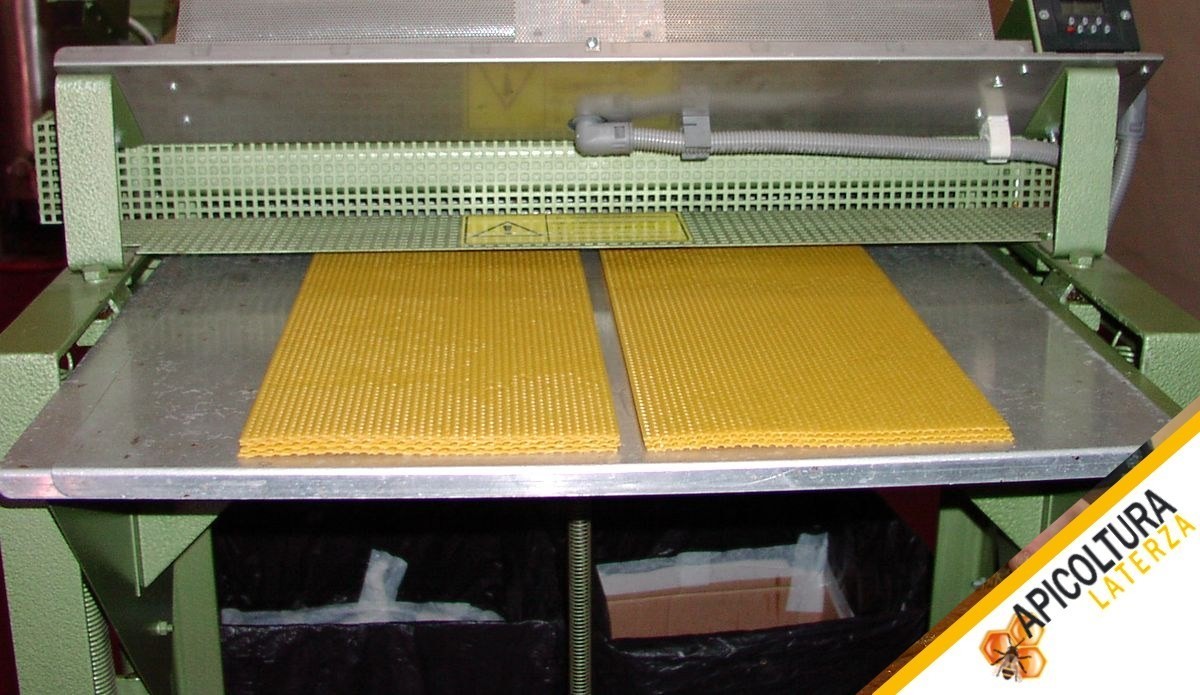
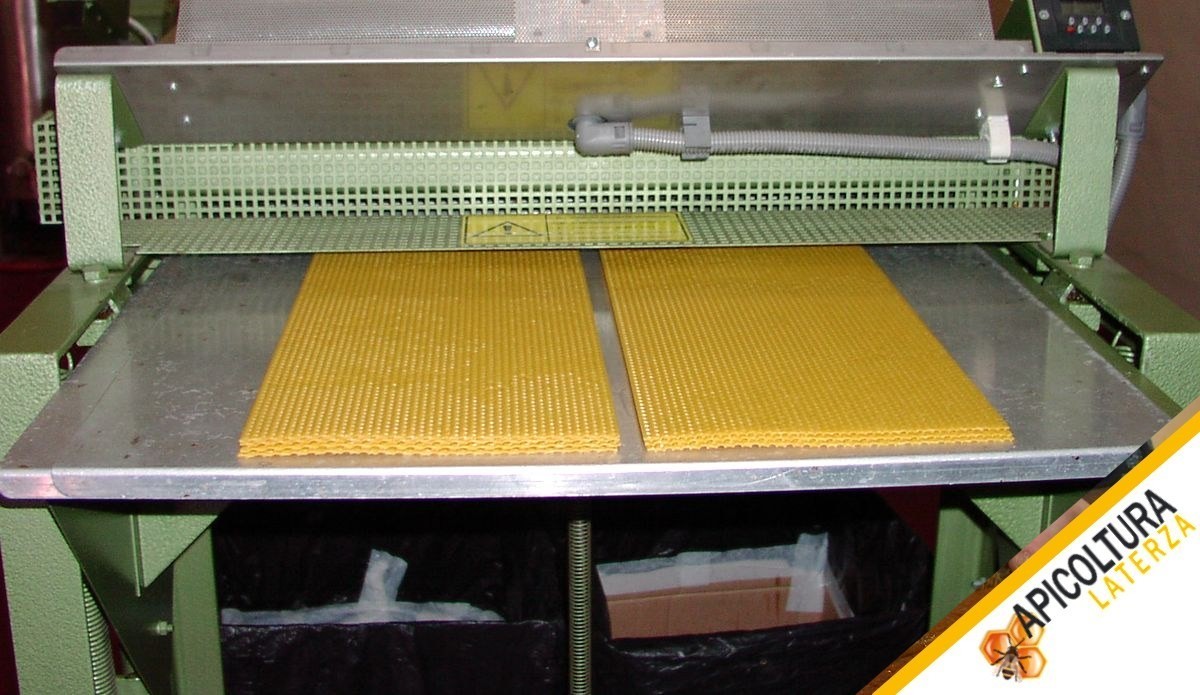
Wax processors almost always work on an exchange basis: you bring in raw wax in blocks, they give you back sheets of foundation, keeping a share for the work or charging a rate per kilo.
Three things to check before you go.
The wax should already be settled and scraped underneath: the cleaner it is, the less it loses. Ask for the exchange terms in advance, because they vary a lot from one processor to the next. And above all, ask how the wax is heat treated.
That last point is the one beekeepers underestimate most. Some brood disease spores survive simple melting perfectly well: serious processors apply a heat treatment well above melting point, held for a defined time, precisely for that reason. If your supplier cannot answer, change supplier.
Adulterated wax: a problem you only see in spring
This has become a real issue in recent years, and it is not a forum legend.
Foundation cut with paraffin or stearin has circulated on the market. It costs less, it looks identical, and the problem appears once the bees work on it: sheets the bees will not draw, combs that stretch or collapse in the heat, patchy brood.
The damage lands in the middle of the season, when there is no margin left to fix it.
The defences are few but effective. Buy from suppliers who declare where the wax comes from. Be suspicious of prices that are too low, because real wax is an expensive raw material. And if you have doubts, test a batch on a few hives before putting it into the whole apiary.
The closed loop: why coming back with your own wax pays
This is the main reason to bother recovering wax, and it is not the saving.
If you take your own wax to the processor and get back foundation made from it, you know where it came from: you know the treatments, and you know you have not bought material of uncertain origin. It is the only genuinely solid way to control what goes back into your hives.
And if you mostly work cappings wax, you start from a pale raw material with few accumulated residues: the loop improves year after year instead of getting worse.
For a small apiary a pure closed loop is not always possible, simply because the kilos are not there. In that case the route is a compromise: recover everything recoverable and buy the rest from a supplier who can tell you what they are selling you.
A simple wax calendar
Wax work fits neatly into the empty spaces of the beekeeping year.
Summer, during extraction: collect the cappings, let them drain and wash off the residual honey. Do not leave them sticky in a sealed bucket, or they ferment.
Autumn: sort the cull combs taken out during the season and set aside the frames to be processed.
Winter: this is rendering time. There is no work in the apiary, the store is cool, and the wax cools slowly on its own.
Late winter: the blocks go to the processor, so the foundation is ready before you actually need it.
Spring: fit the new frames and start the season with combs already prepared, no rush.
Skip this cycle and you end up hunting for foundation in May, and buying in a hurry means buying badly.
Three mistakes to avoid
1. Leaving cappings in a sealed bucket for months. The residual honey ferments, the mass turns sour and attracts moths and store pests. Drain and wash them straight away.
2. Rendering everything together. Tipping cappings, scrapings and black combs into the same container lowers the quality of the whole batch. Your best wax downgrades itself.
3. Keeping combs in the hive as long as they hold together. A comb is not judged by how intact it looks but by how many years it has worked. Regular renewal costs little and prevents a lot.
In short
Wax is the one hive product you can give back to the bees as work already done. Keep the three grades apart, renew a third of the combs every year, render at low temperature in stainless steel and soft water, scrape the bottom of the block, and choose a processor who can tell you how the wax is treated: five simple habits that buy you a calmer season.
The rest is patience. Wax is in no hurry, and treated calmly it pays you back.
If you are reorganising your apiary and need colonies that will actually draw comb, tell us where you stand: foundation is only drawn properly by strong, healthy colonies.
Foundation is drawn by strong colonies
An apiary that renews its combs every year needs populous, healthy colonies, not colonies that are just hanging on. We raise nucleus colonies and selected queens in our own apiaries and deliver them ready to work. Tell us how many colonies you run and what you want to renew: we will tell you where to start.
In Same Category
- Beekeeping Equipment for a Growing Apiary: What You Really Need and in What Order
- Honey Harvest: When to Remove the Supers and How to Get Properly Ripe Honey
- Weak Colonies in Late Summer: Assess, Strengthen or Unite Them Before Winter
- Wasps and Hornets at the Hive: Protecting Bees in Late Summer
- Starting the Season: Spring Checks at the Hive