Hive Materials Compared: Wood, Polystyrene and Sizes, What Really Changes
The material of the hive does not decide how much honey you take. It decides three things: how much weight you lift, how the colony handles heat and cold, and what you can do on the day the flame is needed. Dadant-Blatt dimensions, thermal conductivity, EPS density, four studies that disagree and four questions to decide.
Sooner or later the question comes up, and it usually comes up in front of a catalogue. Wood or polystyrene?
Whoever asks it expects a straight answer. There isn't one, and not because the matter is controversial: because the question is framed badly. The material of the hive does not decide how much honey you will take, nor whether the colony reaches March alive. It decides three far more concrete things, which nobody mentions while showing you the price: how much weight you will lift on a day of supers, how the colony will handle heat and cold, and what you will be able to do on the day you have to disinfect.
Everything else, which is almost everything, depends on how you run the apiary.
In this article we compare wood and polystyrene with figures you can check, and with what the studies have actually measured, including the ones that contradict each other. At the end you will find four questions that lead to a reasoned choice rather than to a creed.
Format comes before material
There is one decision that weighs more than the choice between spruce and expanded polystyrene, and almost nobody makes it consciously: the format.
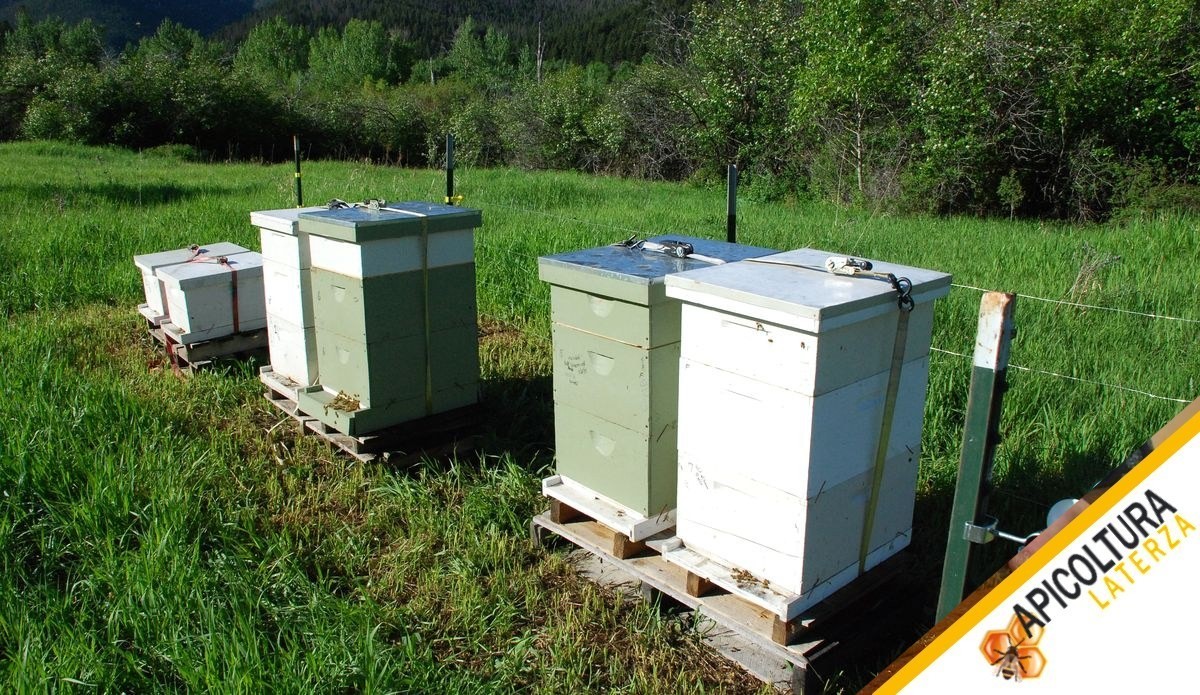
In Italy the reference is the Dadant-Blatt hive. Brood frames measure 435 x 300 mm of working area, with a 470 mm top bar resting in the rebates; super frames have the same width but only 145 mm of depth. The standard brood box takes ten frames, the super nine, and the walls are 25 mm board. There are twelve-frame versions, six-frame boxes for nucs, deep supers and shallow supers.
These numbers look tedious until you end up with two incompatible stores.
The real cost of a disorderly apiary is not the material: it is the time you lose because that super will not sit on that brood box, because one batch of frames has longer lugs, because the crown board of one brand does not close on another maker's box. Anyone growing year on year finds out quickly, and it is exactly why standardisation comes before any upgrade in the buying ladder for equipment.
Pick a format and stay with it. Then, inside that format, argue about the material.
Bee space, the one measurement that is not negotiable
There is a constraint that applies to any material, and it explains why hive dimensions are so rigid.
Bees propolise gaps narrower than about 7 mm and build wax bridges in gaps wider than about 9 mm. In between lies the window where they leave a free passage: that is bee space, and the whole geometry of the movable-frame hive comes from it. The bottom frame sits about 3 cm clear of the floor precisely to give room when the colony grows large.
A badly built hive, wooden or polystyrene alike, shows itself here: if the internal measurements miss that window, every inspection becomes a fight with the hive tool and the brace comb.
What physics says: two numbers and a trap
Spruce, according to the reference values used in building work (UNI 10351), has a thermal conductivity of around 0.10 to 0.12 W/mK. Sintered expanded polystyrene, EPS, sits between 0.031 and 0.040 W/mK according to the technical literature of the Italian trade association.
Three or four times better. It looks like a closed case.
The trap lies in thickness, and in the fact that a honey bee colony is not a refrigerator. A 25 mm spruce wall and a 30 to 40 mm EPS wall already start from a less dramatic ratio than the bare figure suggests. More to the point, insulation acts on only one of the variables in play: the winter cluster does not die of cold, it dies of starvation, of damp or of varroa. A warm hive with a weak, infested colony inside is still a weak, infested colony.
Physics, in short, tells you which material insulates better. It does not tell you which hive winters better.
What the studies actually measured
It is worth being honest here, because the literature does not all point the same way.
A study published in 2004 in the Journal of Apicultural Research (Dodologlu, Dülger and Genç) compared wooden and polystyrene Langstroth hives in Turkey under two feeding regimes. Colonies in wooden hives came out ahead on overwintering survival, winter population loss, brood area, number of frames of bees and low defensiveness.
A 2019 study in the Italian Journal of Animal Science (Erdoğan) compared ten wooden hives, ten polystyrene hives and ten insulated hives made of composite material. The highest overall productivity across all factors went to the insulated ones, with honey production roughly 35% above the wooden hives and 14% above the polystyrene ones.
And a very recent paper, published in 2026 in the Journal of Economic Entomology by the USDA Bee Research Laboratory (Alburaki, Madella, Chan and Corona), followed ten colonies in polyurethane hives and ten in wooden hives for six months. No difference in brood production, varroa infestation or viral load. But the insulated hives held a higher average internal temperature (34.3 °C against 32.8 °C) and a lower relative humidity (57.2% against 60.2%), and above all they lost far less weight over the period: 0.8 kg against 4.8 kg.
Add a fourth result, which clarifies the picture. In 2022, in PLoS One, St Clair, Beach and Dolezal fitted plain insulating covers on wooden hives in Illinois, across 43 colonies. The covered colonies consumed significantly less stores and closed the winter with 4.8% mortality against 27.3% in the uncovered ones.
Read them together and the message is clear. It is not polystyrene that wins: it is insulation that makes the difference, and you can get insulation on a wooden hive too. Where polystyrene does not help is in the rest of the management, and that is where the 2004 trial penalised it.
Weight: the factor that changes your working day
This is the polystyrene advantage nobody disputes, because it is obvious at the first super.
An EPS box weighs a fraction of a 25 mm spruce box. Multiply that by the number of supers you shift on an extraction day, add your back at the end of the season, and you see why beekeepers working alone or moving to the flows get there before everyone else. If you load and unload hives onto a van to follow the bloom, or if you are weighing up contract work such as a pollination service, weight stops being a detail and becomes the main entry.
The other side is just as physical: a light hive flies. In strong wind, or on a roof, you need ballast or a strap holding it down to the floor and the pallet.
Winter: heat retained and damp to be shed
In winter the advantage of insulating material is real, and the weight-loss data confirm it: fewer thermal swings mean less stores burned to hold the cluster.
But there is a counterweight, and it is paid in condensation. A colony produces water vapour, and that vapour has to leave. In a well insulated hive the walls stay warmer and condensation does not form on the sides, which is good; if ventilation is poor, however, moisture builds up and the result is mould on the outer combs and a brood nest that never dries.
The fix is a mesh floor and a crown board that allows exchange, not the material. It is worth going back over the points of wintering: enough stores, the nest reduced to the colony's real strength, the hive tilted slightly forward so water runs out of the entrance.
Summer: insulation works both ways
It is often forgotten, but a wall that holds heat in during winter keeps it out during summer. In an apiary exposed to southern sun that plays in favour of insulating material, provided ventilation is adequate: otherwise the heat the colony itself produces has nowhere to go.
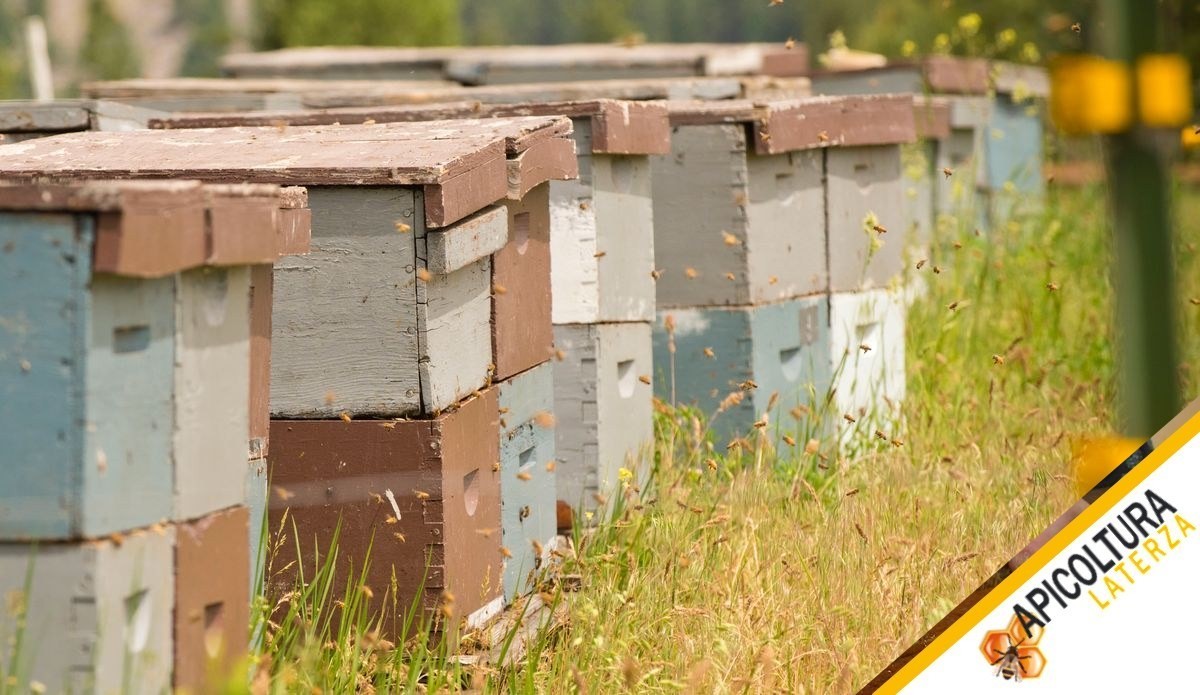
Colour matters as much as material. A pale hive reflects, a dark one absorbs, and on a flat roof the difference is measured in degrees. Anyone keeping bees on rooftops, as we describe in the piece on urban beekeeping, knows it well: up there the summer problem is not cold, it is radiant heat.
How long it lasts and what breaks it
Wood ages predictably. It warps, it splits at the end grain, it rots where water sits, above all on the floor and at the joints. But it can be repaired: a board is replaced, a corner re-glued, a floor rebuilt in half an hour. A wooden hive that is treated and kept clear of standing water lasts decades.
Polystyrene does not rot and does not warp, but it wears differently: it chips at the edges, it scores under the hive tool, it gouges when you scrape propolis off the rebates. Every inspection leaves a mark, and marks do not get repaired.
Here a variable comes in that catalogues print in a corner: density. Serious hives declare high density EPS, around 90 g/l, with plastic reinforcement on the most stressed edges; budget versions drop to 30 kg/m³, and at that density the material gives way under the tool and the bees themselves gnaw it.
If you buy polystyrene, the declared density is the first number to look for. Without it you are comparing two objects that share only a name.
Painting and maintenance
Both materials need protecting, for different reasons.
Wood is treated on the outside with suitable preservatives or oils, never inside, and the treatment has to be redone every few years. It is winter work, done without hurry, and while you are at it you check the joints.
Polystyrene has to be painted because ultraviolet light degrades it: a bare surface yellows and starts to chalk. Manufacturers specify water-based paints, and many hives are sold already painted. That coating has to be renewed; it is not decoration.
In both cases, nothing goes on the inside of the hive. The bees live in there and store honey in there.
The sanitary question: the day you need the flame
This is where the choice of material stops being a preference and becomes a strategy.
Faced with suspected American foulbrood, Italian animal health practice is strict. The disease is among those subject to notification under the veterinary police regulations, the spores of Paenibacillus larvae survive for decades and resist most disinfectants, and the prescribed route for infected material goes through fire. On wood the flame is workable: you scrape, you pass the flame over the internal surfaces, you are working with a material that tolerates heat.
Polystyrene is not. Under load, EPS has a maximum service temperature of around 80 to 85 °C: a flame does not sterilise it, it deforms and melts it. That leaves the chemical routes, such as immersion in hypochlorite or soda solutions, which work on less resistant pathogens but are considered unreliable against foulbrood spores.
In practice: in a serious health scenario a wooden box can be recovered, a polystyrene one almost always has to be destroyed. That is not an argument for rejecting polystyrene, it is an argument for knowing what you are putting on the balance sheet. On the signs to recognise before it gets that far we have written a dedicated guide to brood diseases.
Enforcement is regional: faced with a suspicion, the compulsory step is always the local veterinary service.
Mice, woodpeckers and bees that gnaw
A less dramatic but very real chapter.
Polystyrene is soft, and anything that wants to get into a hive in winter finds that out fast. Mice open a hole overnight, woodpeckers work the walls when food is short, and the bees themselves, on low density material, chew the edges of the entrance and widen it to their own taste.
The countermeasures exist and are trivial: a metal entrance reducer, mesh on the floors, protection where you know the problem is. But they belong in the plan from the first year, not after the first damage.
What it really costs
The list price is the least interesting part of the sum.
A complete polystyrene hive generally costs less than a good quality wooden one of the same format, but service life and replacement cost change the picture. Wood is repaired and resold; polystyrene, once marked, is swapped. On the other hand wood demands periodic maintenance, and that maintenance is hours.
The useful criterion is the same one that applies to all equipment: not what the item costs, but how many minutes per hive per year it saves you, and how much you risk spending in the worst case. A beekeeper with six colonies and one with eighty reach different answers from the same figures.
The third way the studies reward
There is an option that usually gets squeezed out between the two camps, and yet it is the one that came out best in the 2019 trial: the insulated wooden hive.
These hives keep the structure, the repairability and the flame tolerance of wood, and add an insulating layer in the walls or the roof. They cost more, they weigh as much as wood and they do nothing for your back. But from the colony's point of view they do what is needed.
There is also the cheap, clever version of the same idea, and it is the one validated by the 2022 American study: an insulating panel above the crown board, an insulated roof, a winter cover. It costs little, it comes off in spring, and it works on exactly the months when the colony consumes most.
How to choose: four questions
At this point the decision can be made without ideology. Four questions, in order.
How many hives do you move in a year? If you migrate or work alone, the weight of polystyrene outweighs every other consideration. If your hives stay put, weight is not a criterion.
What kind of winter do you get? In the mountains or on the northern plain, insulation really works. In southern Italy, with strong colonies and adequate stores, wood is not penalising you.
What health risk is around you? In an area with known foulbrood outbreaks, being able to flame a box is an advantage measured in hives not destroyed.
How much maintenance will you actually do? Wood asks for winter hours. Polystyrene asks for care all year and replacement once it is marked. Choose the maintenance you will really carry out, not the one you promise yourself.
Three mistakes to avoid
Mixing formats to chase a bargain. Two standards in the same store cost more than any saving on a single item, and the bill arrives in the middle of the season.
Buying polystyrene without checking density. Between 90 g/l and 30 kg/m³ lies the difference between a hive that lasts and one the bees reduce to pieces in two seasons.
Expecting the material to make up for management. No wall insulates against varroa, winter starvation or a spent queen. The hive is a container: what you put inside it counts far more than how it is built.
In short
Wood and polystyrene are not two opposed philosophies, they are two different compromises. Polystyrene gives you lightness and thermal stability, and asks for a careful hand and a health strategy that does not rely on the flame. Wood asks for your back and your maintenance time, and gives back sturdiness, repairability and a way out in the worst cases.
The studies, read without partisanship, say one thing only: insulation counts, not the brand of material, and it counts far less than how you run the apiary.
If you are still deciding where to start, the choice of container comes after the choice of content. For that, the starting point is always the same: healthy colonies, young queens and a start sized on your own experience. If this is your first apiary, the guide to starting a productive apiary sets out every step in order.
A hive is a container. What counts is the colony you put inside it
We rear nucs, mated queens and colonies in our own apiaries, with traceable origin and scheduled deliveries. Tell us what hives you run and where you work: we will tell you plainly which living material is worth starting from.
In Same Category
- Brood Diseases: Reading the Signs and What the Law Requires
- Beeswax: How to Recover Cappings and Old Combs and Get Your Foundation Back
- Beekeeping Equipment for a Growing Apiary: What You Really Need and in What Order
- Honey Harvest: When to Remove the Supers and How to Get Properly Ripe Honey
- Weak Colonies in Late Summer: Assess, Strengthen or Unite Them Before Winter