Varroa Monitoring: How to Count Mites and Know When to Treat
Treating for varroa on a fixed date, without knowing how many mites are actually there, is the most common mistake. This article walks step by step through the powdered sugar shake and alcohol wash counting methods, how to read seasonal thresholds, and why the treatment log is not just paperwork.
Treating for varroa on a fixed date, the same way every year, is the most common mistake and also the most understandable one. A calendar has no idea how many mites your colony actually carries right now. Before choosing a method and a moment to treat, it pays to answer a simpler question that almost nobody asks with any rigour: how much varroa is really in the hive? You do not need a perfect number. You need to know whether you are above or below the threshold, and above all you need to be able to check again afterwards.
Count before you treat, not the other way round
Varroa is present in practically every hive. The useful question is never "is it there?" but "how much?". Treating without counting first means choosing the timing, the method, and even whether urgent action is needed at all, completely in the dark. A proper count takes ten minutes and changes the decision. A treatment that is applied and never checked afterwards is only half the job done: you may have treated a colony that did not urgently need it, or worse, underestimated one that was already collapsing.
The right sample: three hundred bees, not a random handful
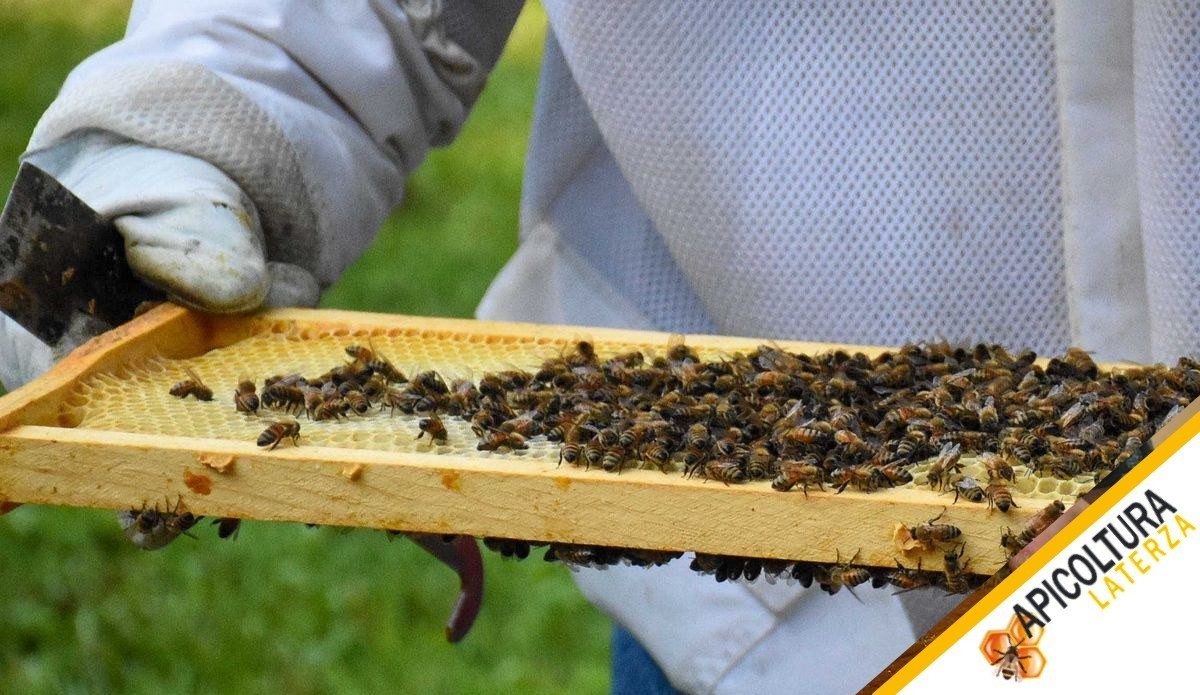
Both reliable counting methods, the powdered sugar shake and the alcohol wash, start from the same collection: around 300 adult bees taken from one or two brood frames, avoiding the queen. Three hundred bees is roughly half a cup, loosely packed. A smaller sample is not an acceptable shortcut, it is a number that means almost nothing, because statistical variation on a handful of individuals is far too high. It is worth the extra thirty seconds to collect enough bees rather than repeating the test because the first number does not add up.
The powdered sugar shake, step by step
Add about two tablespoons of powdered sugar, sifted fine, into the jar with the bees. Shake vigorously for at least a minute, so the sugar coats every bee and loosens the mites from their bodies. Then wait, without touching the jar, for three to five minutes: rushing this step is the single most common cause of undercounting. Shake again, invert the jar over a light-coloured pan and shake it like a salt shaker until no more mites fall out. A light mist of water dissolves the remaining sugar and makes the mites easy to see. The bees, dazed but alive, go back into the hive: this is the only one of the two methods that does not sacrifice them.
The alcohol or soap wash: less gentle, more accurate
The second method completely covers the sample with ethyl or isopropyl alcohol, or with a low-sudsing soap. Swirl vigorously for at least a minute, then pour the liquid through a mesh screen that holds back the bees and lets the mites fall into a white pan underneath. This time the sampled bees do not survive, but the result is more reliable: the wash recovers a noticeably higher share of mites than the sugar shake, which tends to undercount. It is worth using when the decision is close, for example when the sugar shake result sits right on the threshold, or to confirm whether a treatment actually worked.
Doing the maths: the formula that turns a number into a decision
The raw mite count in a pan cannot be compared from one hive to another, because it depends on how many bees ended up in the sample. What matters is the percentage: mites counted, divided by bees in the sample, multiplied by one hundred. Twelve mites out of three hundred bees works out to four percent, meaning four mites per hundred bees. That is the figure to write in your log and to compare against the thresholds, not the raw count.
How many colonies to sample in an apiary
If the apiary has fewer than ten colonies, it is worth sampling every one: the mite load can vary considerably even between neighbouring colonies. In larger apiaries a representative sample is enough: at least eight randomly chosen colonies, or three to five percent of the total if you manage several apiaries, always including colonies from both the centre and the edges. The edges are not equivalent to the centre: drift between neighbouring colonies also carries mites with it, and an isolated colony can hide a very different load from its neighbours.
The sticky board: what natural mite fall tells you, and its limits
A screened bottom board with a collecting tray underneath lets you count mites that fall on their own, without opening the hive or touching the bees. It is convenient, it causes no disturbance to the colony, and it is useful for tracking a trend over time or for a quick check after a treatment. It does have real limits, though: ants and other scavengers can remove the mite bodies before you get to count them, and it is hard to translate the daily fall into an estimate of the total mite population in the hive, because the count varies a great deal from one day to the next. For this reason international guidelines treat it as a supporting method, to be used alongside, not instead of, sampling adult bees directly.
The European surprise: some products are built around natural fall
Here is a point that surprises anyone who has only read North American guides. While they treat natural mite fall as a secondary check, the label of several veterinary products registered for beekeeping use in Europe ties the treatment threshold directly to it. To give a concrete example, without going into dosing, which is always a matter for the product label itself: some protocols call for the first spring treatment once natural fall exceeds one mite per day while the colony population is growing, and the first autumn treatment once it exceeds four mites per day while the population is declining, with any repeat treatment decided by recounting the mites that fall over the following days. The exact detail changes from product to product. For a comparison of the active ingredient families available and their timing, see our article on late summer varroa treatment.
Why waiting is expensive: exponential growth
When brood is present, the varroa population roughly doubles every month. That is not a figure of speech: official guidelines for controlling the infestation give an example worth keeping in mind. Starting from fifty mites in February, monthly doubling takes you to roughly three thousand two hundred by August. Starting from one hundred you reach six thousand four hundred, starting from two hundred you pass twelve thousand. A number that looks negligible in March, left unchecked, can become unmanageable right when the colony should be preparing for winter.
The thresholds: when the number really says "now"
Thresholds are not a single fixed value all year round, they change with the colony's phase. In the dormant phase, with little or no brood, below one percent no urgent action is needed, above it treatment is worth considering. During spring population increase the margin widens slightly, to around two percent, with treatment recommended above two to three percent. At the seasonal population peak the threshold stays around two percent, with treatment recommended above three percent. In the population decrease phase, when the colony is rearing the bees that must survive winter, the margin tightens again. One detail worth remembering: even at around three percent infestation, losses over time are never zero. Waiting for a round number like five or ten percent almost always means you have already missed the window to act without damage.
How often to monitor in a year
A single count, done once, tells you very little. It is worth monitoring at least four times a year: at the spring build-up, before and after the main honey harvest, in late summer, and before closing the season ahead of winter. And one rule always applies, whatever calendar you follow: after every treatment, check again. Only a fresh count tells you whether the treatment actually worked or whether the colony is still above threshold. In practice at least two interventions a year remain essential, one right after the main harvest and one before wintering: constant monitoring is what decides whether more are needed in between.
The treatment record is not a bureaucratic detail
Under the EU regulation on veterinary medicines, every varroa treatment must be logged within forty-eight hours, and for commercial beekeeping the record book must be stamped by the competent veterinary service. The purchase receipt for the product must also be kept. This is not just paperwork: a well-kept log, with count dates sitting next to treatment dates, is the simplest tool for seeing at the end of the season whether the strategy worked or needs changing next year.
Three mistakes to avoid
First: sampling fewer than three hundred bees and assuming the result is still indicative, when in reality it is mostly statistical noise. Second: relying solely on natural mite fall from the sticky board to decide, without ever running a proper sample on adult bees when the decision is a close one. Third: treating and never checking again, assuming the job is done when the only way to actually know is a fresh count in the following weeks.
Counting varroa does not remove the need to decide, but it turns the decision from a guess into an informed one. A sample taken properly, a threshold read with judgement and an up to date log are worth more than any fixed calendar, because they give you what actually matters: the real state of the colony, right now, in your hive.
Healthy colonies handle treatment better
An accurate count tells you when to act, but how well a colony responds to treatment also depends on how strong it is to begin with. We select and raise nucs, colonies and queen bees ready for the season ahead. Tell us where you stand with varroa monitoring in your apiary: we will help you work out what you actually need.