Drifting and Robbing: How Apiary Layout Causes Them
Losing bees is not always a brood-health problem: sometimes it simply comes down to where and how the hives are placed. This article looks at what research says about drifting and robbing, why identical rows make both risks worse, and how to lay out the apiary to actually reduce them.
A beekeeper losing bees does not always have a health problem on the brood. Sometimes the problem is much simpler: where and how the hives were placed. Drifting and robbing are two different phenomena, but they share a root cause that almost always goes unnoticed, the physical layout of the apiary.
Two words that get mixed up
Drifting and robbing are sometimes used as synonyms, but they describe opposite behaviours. In drifting, a newly emerged or returning bee enters the wrong hive by mistake and is accepted without issue. In robbing, foragers from a strong colony deliberately enter a weak hive to steal its stores, overcoming the resistance of the guard bees. The first is a tolerated orientation error, the second is an attack that gets repelled for as long as possible.
What drifting actually is
Young bees learn the position of their own hive during orientation flights, the first short flights outside the colony in which they memorise landmarks around the entrance. If two hives are identical, close together and in a row, the mistake is almost guaranteed: the bee comes back, but enters the wrong one. Under normal conditions of good forage, guard bees have no reason to reject her: the colony odour of a newly emerged bee is not yet distinct enough to raise suspicion, and she is let in.
How common it really is, numbers few people know
Drifting is not a rare exception. A landmark study by Pfeiffer and Crailsheim (1998, Insectes Sociaux) individually marked hundreds of newly emerged bees, reintroducing them into their own hive or a neighbouring one: in later checks, between 50 and 90% of marked bees had left their hive of origin, and about 15% had changed colony more than once in their lifetime. The same authors estimate that in some apiaries up to 40% of the workers present in any given hive were not born there.
Why long, identical rows make it worse
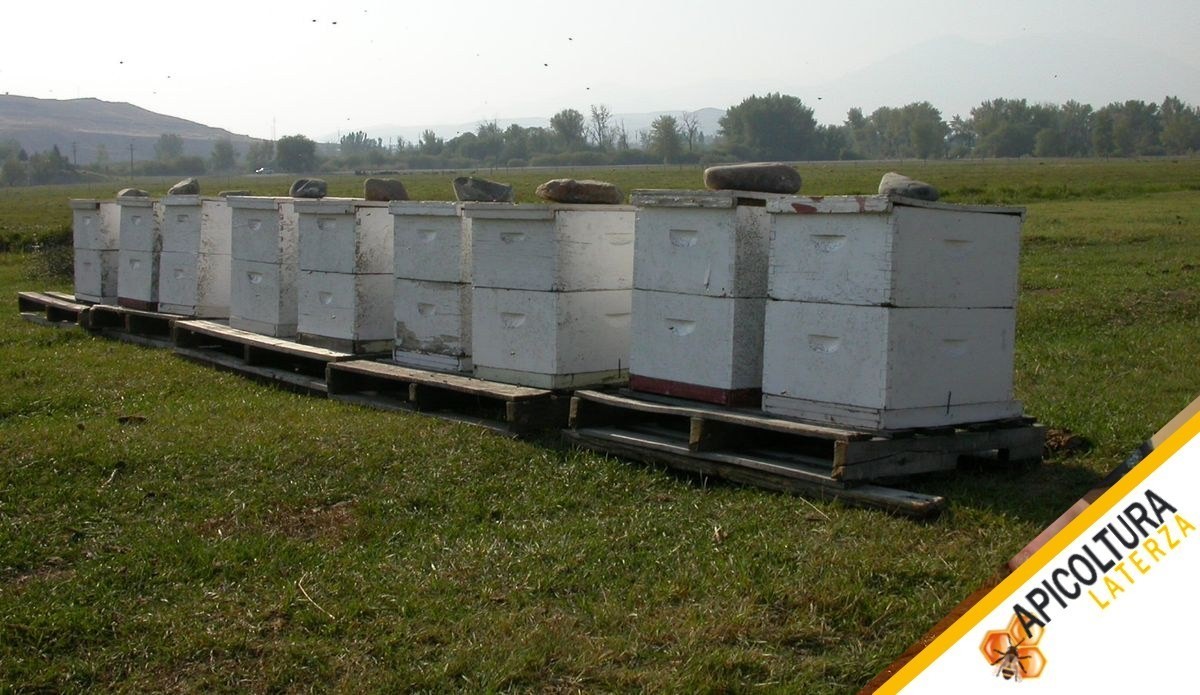
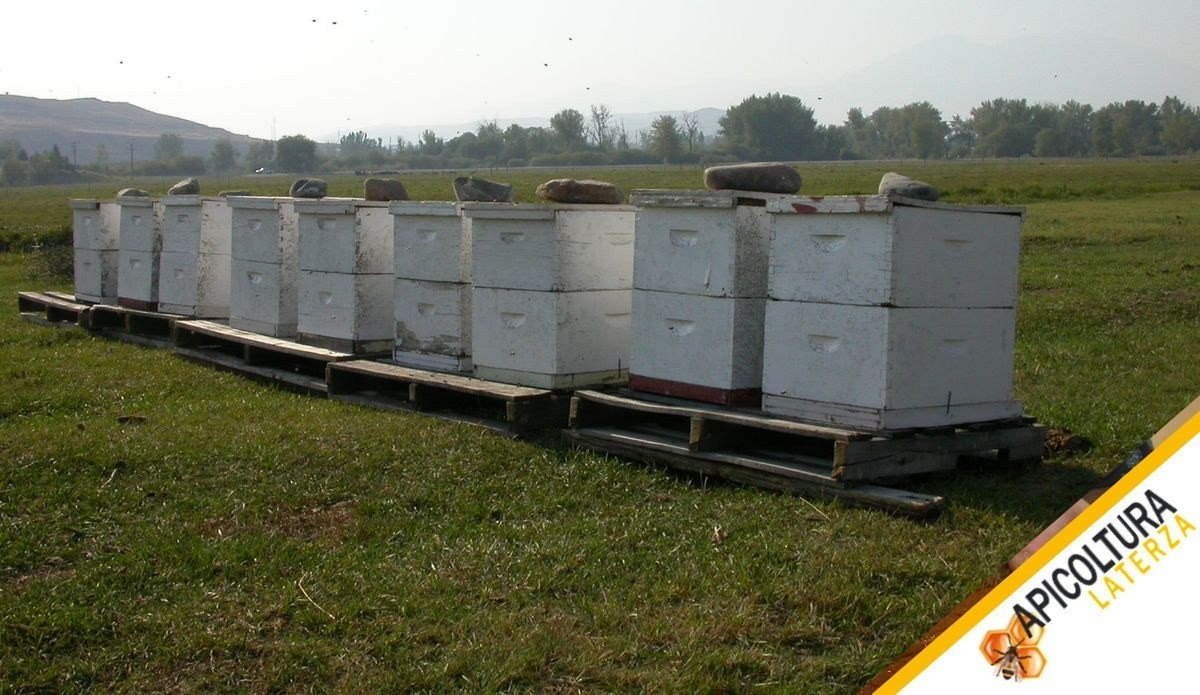
The most common setup, identical hives in a straight row, is also the worst for drifting. Historical research on the topic, starting with Free's work in the 1950s and continued by Jay in the 1960s and 1980s, found a consistent pattern: in rows of identical hives, colonies in the middle lose bees to their neighbours far more than colonies at the ends, which tend to gain instead. In one such experiment, in a row of three hives, the share of marked bees that drifted from the centre hive to its neighbours reached 35%.
The direct proof: one metre versus ten metres
The link between spacing and drifting was measured directly by a study published in 2019 in PLOS ONE (Dynes and colleagues), which compared two apiary configurations: a high-density one, hives one metre apart, all painted white, entrances facing the same direction, and a low-density one, hives ten metres apart, different colours and symbols, different heights, entrances facing outward. The result: 25.0% of marked bees drifted in the high-density configuration, against 7.5% in the low-density one, almost a third. This is not a cosmetic detail: in the same experiment, varroa load was higher in the closely spaced hives, honey production was lower, and after two winters half of the infested colonies in the low-density configuration had survived, against none in the high-density configuration.
Why drifting is not a harmless problem
If a bee enters the wrong hive and is accepted, the receiving colony ends up with one extra forager. The real issue sits upstream: drifting dilutes the actual strength of colonies, systematically favouring the ones that are already more populous and penalising the weaker ones, which lose further workforce right when they need it most. And the bees that move around carry phoretic varroa mites with them, acting as a passive courier linking colonies that would otherwise be separate: this is one reason why a well-executed treatment on one hive can lose its effect if the neighbouring hive stays infested, as explained in our article on late-summer varroa treatment.
What robbing is, and why it is different
Robbing begins when some foragers, usually from a strong colony, find a poorly defended source of stores, a weak hive, a queenless one, or simply one left open too long during an inspection, and return to recruit more nestmates. This is not an orientation mistake: it is a shift in foraging strategy, and it becomes more likely the scarcer nectar forage gets on the land, typically in late summer.
The guards' threshold: why it lets bees through sometimes and not others
What decides whether a robbing attempt succeeds or gets repelled is the behaviour of the guard bees at the entrance, and it is anything but fixed. A now-classic study by Downs and Ratnieks (2000, Behavioral Ecology) observed guard bees across a transition from nectar dearth to abundance: during the weeks of scarcity, guards accepted around 80% of experimentally introduced nestmates but only 25% of non-nestmates, a strict filter. As nectar availability increased, the threshold gradually dropped until the guards accepted almost everyone, nestmates and strangers alike. The same guard bees that, during a strong flow, let almost everyone through can, in autumn, firmly turn intruders away, and it is exactly during that scarcity that a weak hive risks being overwhelmed.
Weak colonies pay twice
A sparsely populated colony has fewer guard bees available, so a thinner line of defence right when robbing is most likely. But there is a second, less discussed mechanism: a weak or queenless colony, with fewer bees at the entrance compared to its neighbour, is also recognised less quickly by its own returning bees, resulting in a higher drift rate toward the strong hive next door. The result is a spiral: the weak colony loses bees to drift toward its strong neighbour, grows weaker still, and becomes an easier target for robbing by that same neighbour or by other opportunistic foragers. As covered in our article on weak colonies in late summer, recognising a struggling colony early is the first step to breaking this spiral.
Laying out the apiary to reduce both risks
The good news is that the two countermeasures overlap almost completely, because the underlying cause is the same: stop the hives from looking identical and sitting all together. In practice: break long rows into small, spaced-out groups, alternate entrance orientation instead of lining them all up the same way, paint hives in different colours or add a recognisable mark above the entrance, vary the height or position slightly from one group to the next. You do not need huge distances: the study cited above measured a clear difference simply by going from one metre to ten metres between hives, and even a small apiary can see a real improvement without a complete redesign.
Weak or queenless hives need isolating, not placing next to the strong ones
A common mistake is putting a newly formed nuc or a queenless colony next to the apiary's most productive hive, often simply because it is convenient or there is free space right there. It is the worst possible pairing: the weak colony loses bees to drift toward its neighbour, and that same neighbour, should forage drop, is the first candidate to rob it. Better to keep it in a corner of the apiary, with an entrance reducer fitted to narrow the opening, so that even a handful of guard bees can control it.
The mistakes beekeepers cause themselves
Many robbing episodes do not happen by chance but from a string of small lapses: syrup spilled while feeding, super frames left uncovered for even a few minutes, lengthy inspections with the hive open right in the late-summer weeks when the nectar flow stops. It only takes the scent of honey or syrup spreading in the air for foragers from nearby hives to start exploring, and once a breach is found the behaviour reinforces itself. Feeding at the end of the day rather than in the heat, and closing hives up promptly after every check, cuts down on the opportunities considerably.
Three mistakes to avoid
First: lining up every hive in a single straight, identical row, thinking it is purely a matter of tidiness. Second: placing a weak nuc or a newly introduced colony right next to the strongest hive in the apiary. Third: leaving hives open too long, or feeding syrup in the open during the day, precisely in the late-summer weeks when natural forage stops and guard bees lower their tolerance threshold.
Drifting and robbing cannot be eliminated entirely, they are part of natural bee behaviour. But the share that depends on how the apiary is laid out can be reduced with a few placement choices, knowing that the first ones to benefit are always the strongest colonies.
Strong colonies defend themselves better
A good apiary layout reduces the risk, but everything starts with the strength of the colonies you put in it. We select and raise nucs, colonies and queen bees ready to defend themselves and produce. Tell us how your apiary is organised: we will help you work out what you actually need.
In Same Category
- Organic Beekeeping: What Actually Changes in Apiary Management
- Beekeeping Site Agreements: Terms and Fees with the Landowner
- The Italian Beekeeping Register: Registration, Apiary Sign and Census
- Migratory Beekeeping: When Moving Hives Really Pays
- Selling Honey: Labelling and Direct Sale Without Mistakes