Organic Beekeeping: What Actually Changes in Apiary Management
Knowing what organic beekeeping is does not tell you what actually changes day to day. This article goes rule by rule through the concrete requirements of EU Regulation 2018/848: conversion period, wax, the 3 km forage radius, feeding, varroa treatments and record keeping.
On our blog we already explained what organic beekeeping is, and we shared our own experience producing organic honey. Here we start from a different angle: what actually changes, rule by rule, in the day to day management of an apiary once you move to organic. It is not a label you add at the end, it is a set of rules that shape what you can do every week in the apiary, under EU Regulation 2018/848 and implementing Regulation EU 2020/464.
The conversion period: 12 months, not a switch
The regulation sets a 12 month conversion period for bees (Annex II, Part II, point 1.2.2, letter f). It does not simply mean waiting a year: during those 12 months the apiary must already be managed under organic rules, wax included. Only at the end of the period, and with certification from the control body, can the products be sold as organic.
Wax: the most misunderstood rule
During conversion, wax must be replaced with wax from organic beekeeping. The regulation allows an exception, and this is the detail many beekeepers skip over: non organic wax can only be used when three conditions apply together. First, organic wax is not available commercially. Second, it is demonstrated that the non organic wax is free of substances not authorised in organic production. Third, the non organic wax used comes from cappings. The Italian implementing decree also spells out how the first point must be proven: at least two written requests to organic wax suppliers, with a negative reply or no reply within 5 days, kept on file for the control body together with lab results on the absence of prohibited substances.
Which bees you can keep: local breeds and the 20% cap on queens
The regulation favours Apis mellifera and its local subspecies. In Italy the implementing decree goes further: breed choice must favour native breeds according to their geographic distribution, Apis mellifera ligustica, Apis mellifera sicula in Sicily, and in border areas Apis mellifera carnica and Apis mellifera nigra, together with hybrids from free crossing with the breeds of neighbouring countries. For apiary renewal there is a precise threshold: 20% per year of the queen bees and swarms in an organic production unit can be replaced with non organic queens and swarms, provided they are placed in hives with combs or foundation sheets from organic production. In small apiaries, where 20% amounts to less than one unit, the regulation still guarantees the replacement of at least one swarm or one queen per year.
Where an organic apiary can be: the 3 km radius
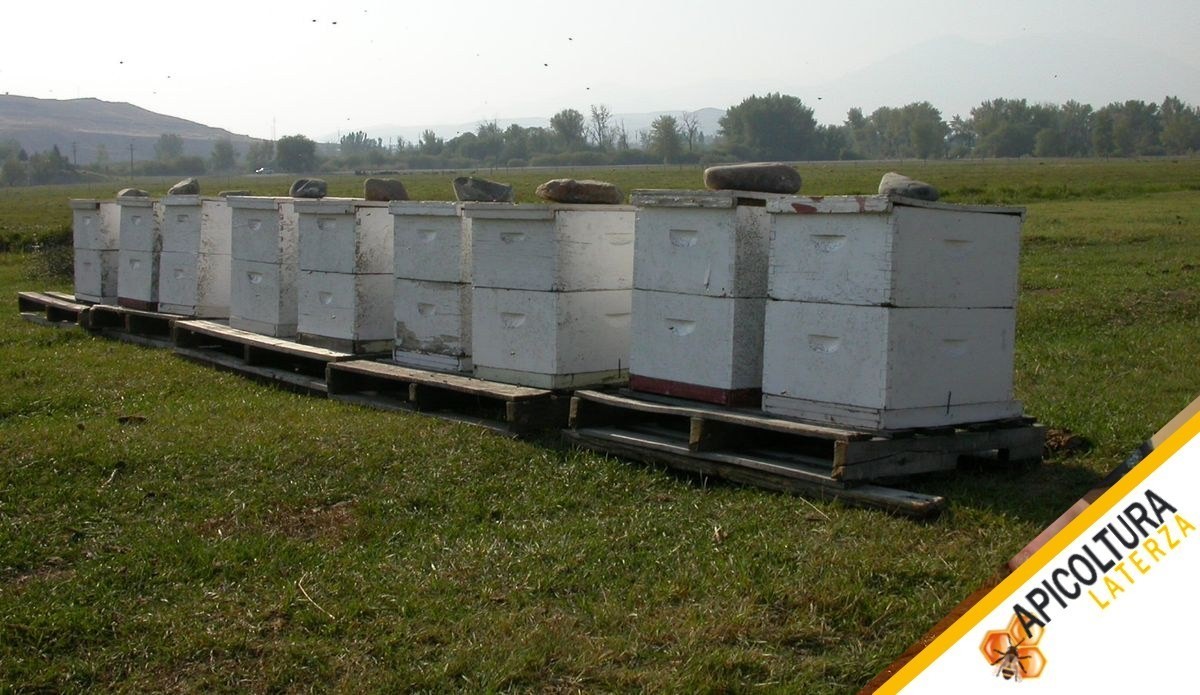
This is the point that trips up most beekeepers considering conversion. The apiary location must be such that, within a 3 km radius, the nectar and pollen sources consist essentially of organic crops, wild vegetation or crops treated only with low environmental impact methods. The requirement does not apply to areas outside the flowering period or when the colonies are dormant, and a temporary derogation applies if colony survival is at risk. The core point remains: before starting conversion it is worth mapping what is actually within 3 km of the apiary, not just the plot where the hives stand.
What has to be in the hives
Hives and equipment must be essentially natural materials, and must not pose a risk of contamination for the environment or for the apiary products. Only natural products can be used inside the hives: propolis, wax and vegetable oils. And the wax for new frames must come from an organic production unit, not only the wax used during conversion.
Feeding: emergency only, and always organic
The baseline rule is that at the end of the production season, enough honey and pollen stores are left in the hives for the colony to get through winter. Artificial feeding is not routine practice under organic rules: colonies may only be fed when their survival is threatened by adverse weather conditions (the Italian decree gives insufficient stores and forage sources, or the risk of infectious disease spreading, as examples), and in that case only with honey, pollen, sugar or sugar syrups, always organic. A natural disaster derogation extends the same possibility to threats other than weather.
Varroa under organic rules: what is allowed
To control varroa the regulation allows formic acid, lactic acid, acetic acid and oxalic acid, together with menthol, thymol, eucalyptol and camphor, the same natural substances we covered in our article on late summer varroa treatment. Drone brood removal is also allowed, but only as a tool to contain Varroa destructor infestation, not as a general practice. To protect frames, hives and combs from pests, only rodenticides in traps and substances authorised for organic production are allowed, and for disinfecting apiaries only physical treatments, steam or direct flame.
If a synthetic treatment is needed: what really happens
If, despite preventive measures, a colony is still sick or infested, it must be treated immediately and, if necessary, isolated in a dedicated apiary. Here the rule is strict: if the treatment uses allopathic products obtained by chemical synthesis, antibiotics included, the treated colonies must be isolated in dedicated apiaries and the wax must be completely replaced with wax from organic beekeeping. After treatment, those colonies go back under the 12 month conversion period, as if starting over. That is the real cost of an emergency treatment outside the allowed list, and it is a decision worth discussing with the control body before acting, not after.
Two practices banned regardless
The regulation adds two animal welfare bans that apply regardless of everything else: destroying bees in the combs as a method of harvesting apiary products is prohibited, and clipping the wings of queen bees is prohibited.
Honey extraction changes little, but is strict on two points
For the rest, honey extraction stays the process you already know. The regulation steps in on two precise details: synthetic chemical repellents cannot be used during extraction, and combs containing brood cannot be used to extract honey. Two simple rules, but easy to forget if you work with the same habits as always.
The records the control body wants to see
The least talked about part of conversion is the paperwork, but it matters as much as the rest. You must keep a map at an adequate scale, or the geographic coordinates, of the hive locations, to prove that the areas accessible to the colonies meet the requirements of the regulation. The apiary register must record the name of any product used for feeding, the dates, the quantities and the hives it was used in. And alongside hive identification, the area where the apiary is located and the period of any move must be recorded.
When conversion is actually worth considering
Taken together, the list is not an insurmountable obstacle, but it is not a detail to add along the way either. It makes sense to start from the 3 km radius around the apiary, because that is the constraint that decides whether conversion is realistic before you even begin. Then comes day to day management, wax, feeding, treatments, records, all choices that work with organic rules only if applied consistently, not just when the inspector visits.
Conversion starts with healthy bees
Wherever you start from, organic conversion only holds up if the colonies you begin with are strong and well managed. We breed and select fertile queen bees and healthy nucs, ready for your apiary. Tell us where you are at: we will help you work out what you actually need.